|
Research highlights of Ajeet's group |
|
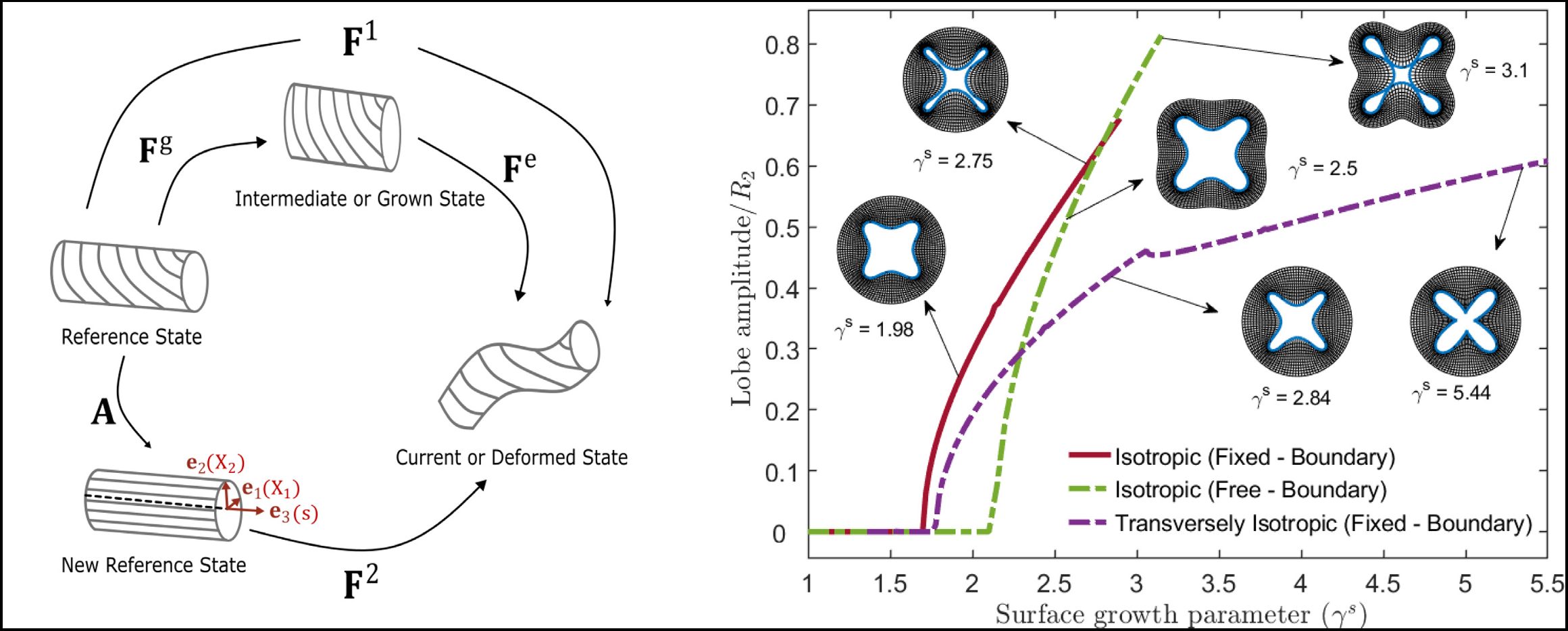
In this study, a scheme is developed to obtain the natural shape and stiffnesses of rod-like growing elastic bodies modeled as a special Cosserat rod. The scheme allows the rod's cross-section to have arbitrary shape. The rod material is also allowed to undergo arbitrary volumetric and surface growth. The Helical Cauchy-Born rule is employed to first generate a helical rod in which the rod's strain parameters are imposed uniformly along its arclength. This uniformity in strain field leads to the reduction of three-dimensional nonlinear equations of morphoelasticity from the entire rod body to its cross-sectional plane. The governing equations for the deformation of the rod's cross-section are then derived considering both volume and surface growth. Semi-analytical expressions of stress resultants and stiffnesses of the rod are further derived in terms of the rod's prescribed strains, growth parameters and the unknown deformed cross-section. Upon setting the stress resultants to zero, one obtains the natural shape of the rod. A finite element formulation is also presented to solve the non-linear cross-sectional morphoelasticity problem. To elucidate our computational tool, several numerical simulations are performed involving volumetric uniform and differential axial growth, isotropic surface growth and active filaments.
1.
Roushan Kumar, Ajeet Kumar, Growth-modulated natural shape and stiffnesses of elastic rods modeled as a special Cosserat rod, EJMSOL/A, 116 (2026), 105943 |
|
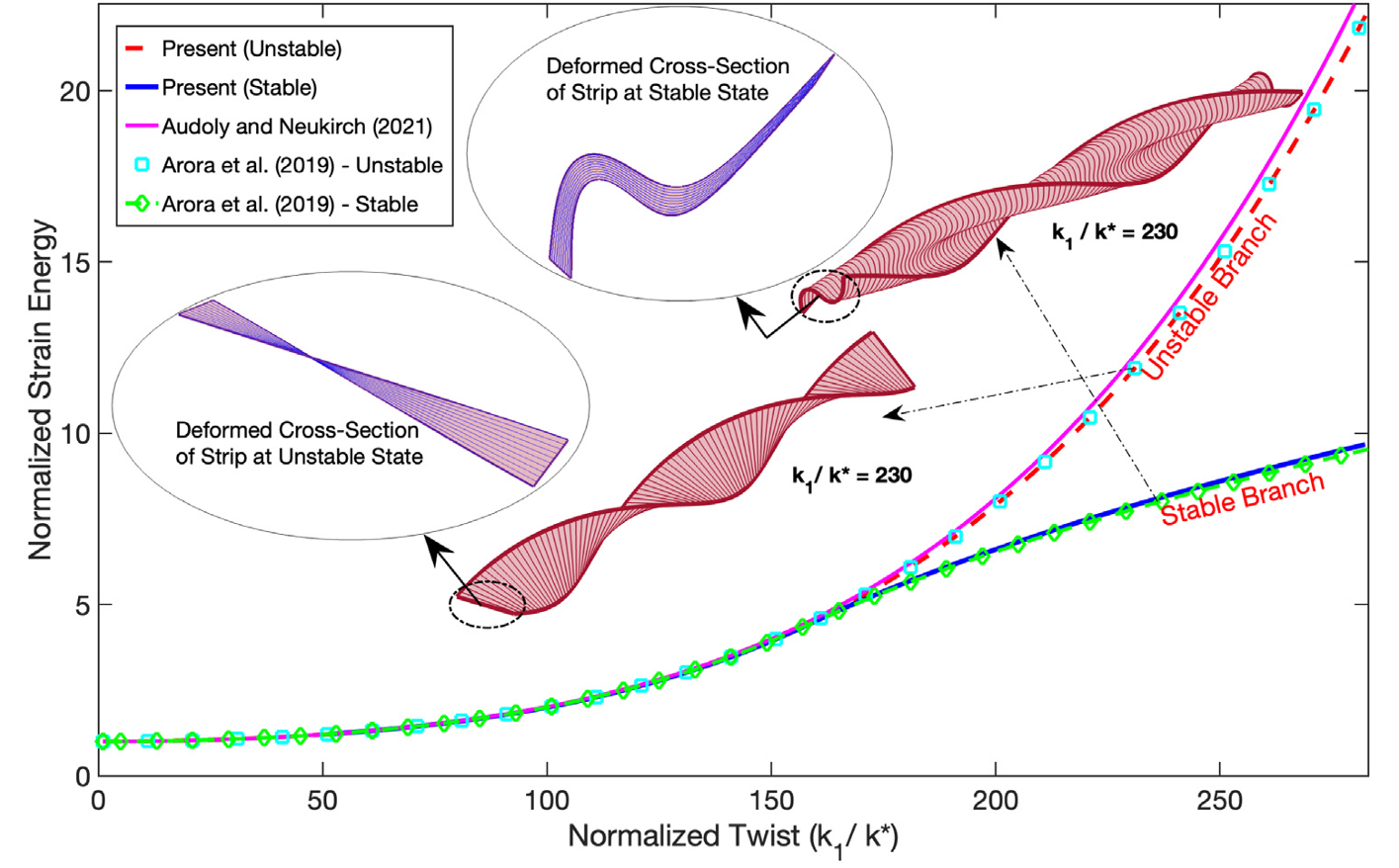
Homogenization of strip-like structures as an elastic rod This study presents a computational approach to obtain nonlinearly elastic constitutive relations of strip/ribbon-like structures modeled as a special Cosserat rod. Starting with the description of strips as a general Cosserat plate, the strip is first subjected to a strain field which is uniform along its length. The Helical Cauchy–Born rule is used to impose this uniform strain field which deforms the strip into a six-parameter family of helical configurations — the six parameters here correspond to the six strain measures of rod theory. Two vector variables are introduced to model the position of the deformed centerline of the strip’s cross-section and to model orientation of thickness lines along the strip’s width. The minimization of the strip’s plate energy under the constraint of the aforementioned uniformity in strain field reduces the partial differential equations of plate theory from the entire mid-plane of the strip to just a system of nonlinear ordinary differential equations along the strip’s width line for the above mentioned two vector variables. A nonlinear finite element formulation is further presented to solve this set of ordinary differential equations. This, in turn, yields the strip’s stored energy per unit length as well as the induced internal force, moment and stiffnesses of the strip for every prescribed set of six strain measures of rod theory. The proposed scheme is used to study uniform bending, twisting and shearing of a strip. For the case of uniform twisting and shearing, the strip is also seen to buckle along its width into a more complex configuration which are accurately captured by the presented scheme. We demonstrate that the presented scheme is more general and accurate than the existing schemes available in the literature. 1. Roushan Kumar, Vivek Agarwal, Ajeet Kumar, A computational approach to obtain nonlinearly elastic constitutive relations of strips modeled as a special Cosserat rod, CMAME, 418(2024), 116553
|
|
Motion of filament-like structures in fluid media based on slender body theory The motion of filament-like structures in fluid media has been a topic of interest since long. In this regard, a well known slender body theory exists, wherein the fluid flow is assumed to be Stokesian while the filament is modeled as a Kirchhoff rod which can bend and twist but remains inextensible and unshearable. In this work, we relax the inextensibility and unshearability constraints on filaments, i.e., the filament is modeled as a special Cosserat rod. Starting with the boundary integral formulation of Stokes flow involving the filament’s surface velocity and fluid traction that acts on the filament surface, the method of matched asymptotic expansion is used to first obtain a leading-order representation of the boundary integral kernels in the filament’s aspect ratio. Upon further collecting the coefficients of sine and cosine terms, the zeroth-order Fourier mode yields a line integral equation relating the rod’s centerline velocity with the distributed fluid force that acts on the filament. The presence of line integral makes the relation non-local in nature. On the contrary, the first-order Fourier mode yields a simpler local relation between the rod’s angular velocity and the distributed fluid couple. The presented theory is demonstrated with numerical examples of tumbling of filaments in background shear flow, twirling-whirling trasition in spinning filaments etc. Mohit Garg, Ajeet Kumar, A slender body theory for the motion of special Cosserat filaments in Stokes flow, Mathematics and Mechanics of Solids (doi: 10.1177/10812865221083323) |
|
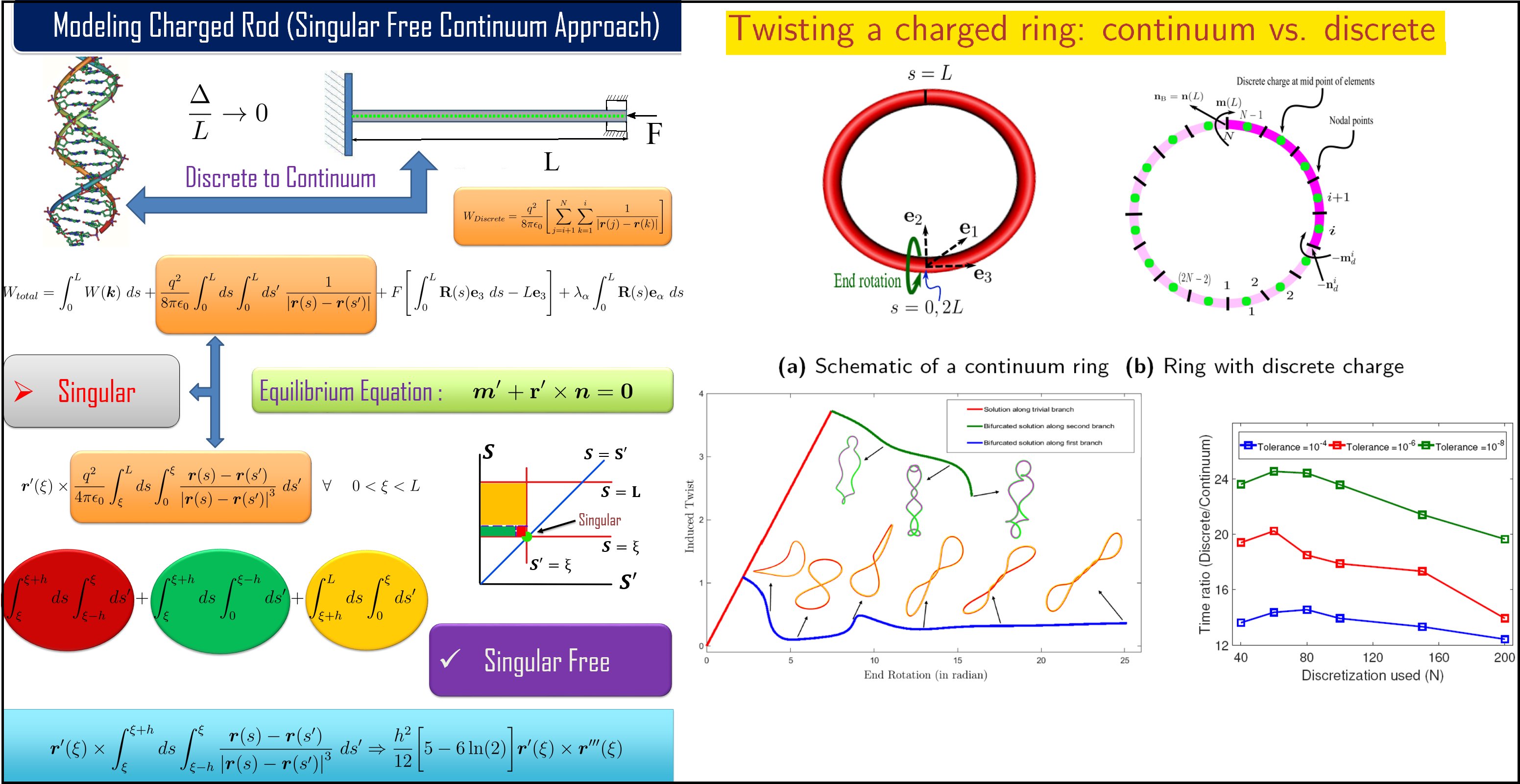
Self-contact/ intertwining is a ubiquitous phenomena in nature, e.g., helical patterns in plant tendrils, super coiling in a DNA molecule, self-folding of various proteins, theory of cables, knots etc. to name a few. Understanding the mechanics of such self-intersecting configurations is very interesting but at the same time challenging to model since one has to avoid self-penetration. Another difficulty is to include the effect of electrostatic charge that is distributed over the length of such structures such as in DNA - electrostatic forces have inverse square singularity. Our group has developed a singularity free formulation and its efficient numerical implementation for the spatial deformation of Kirchhoff rods having uniformly distributed electrostatic charge. Due to the presence of continuously distributed charge, the governing equations of the Kirchhoff rod become a system of integro-differential equations which is singular at every arc-length. We show that this singularity is of removable type which, ones removed, makes the system well defined everywhere. No cut-off length or mollifier is used to remove this singularity. An efficient finite difference scheme is also worked out for the numerical solution of this singularity free system of equations. The numerical scheme turns out to be computationally efficient compared to an alternate approach in which the uniformly distributed charge is modeled by placing equivalent lumped charge at discrete locations along the rod. The scheme is demonstrated through an example problem of supercoiling in a charged elastic ring when twist is inserted in it. The group has also developed an algorithm for the detection of potential contact points and further avoidance of self-penetration. We are actively pursuing this problem to expand it to dynamic phenomena. 1. Raushan Singh, Jaya Tiwari, Ajeet Kumar, Self-contact in closed and open Kirchhoff rods, International Journal of Non-Linear Mechanics (doi: 10.1016/j.ijnonlinmec.2021.103786) 2. Raushan Singh, Ajeet Kumar, A singularity free formulation for Kirchhoff rods having uniformly distributed electrostatic charge, Computer Methods in Applied Mechanics and Engineering, 367 (2020), 113133 |
|
Magnetoelastic theory for Kirchhoff rods with application to soft robotics A theory is derived for finite and spatial elastic deformation of rods under the influence of arbitrary magnetic field and boundary condition. The rod is modeled as a Kirchhoff rod and is assumed to have uniformly distributed array of uniaxial spheroidal paramagnetic inclusions embedded in it all pointing in the same direction in the undeformed state. The governing equations of the magnetoelastic rod are derived which are further non-dimensionalized and linearized to investigate buckling in such rods. Analytical expressions for the onset of buckling from the rod's trivial state are obtained in terms of loading parameters (applied magnetic field, axial load, torque) as well as geometric (inclusion orientation in the undeformed state) and material (ratio of bending and torsional stiffnesses) parameters for different combinations of boundary conditions. The presented work can be useful in simulation and design of magnetic soft continuum robots. Darius Diogo Barreto, Shashank Saxena, Ajeet Kumar, A magnetoelastic theory for Kirchhoff rods having uniformly distributed paramagnetic inclusions and its buckling, International Journal of Solids and Structures (doi: 10.1016/j.ijsolstr.2021.111147)
|
|
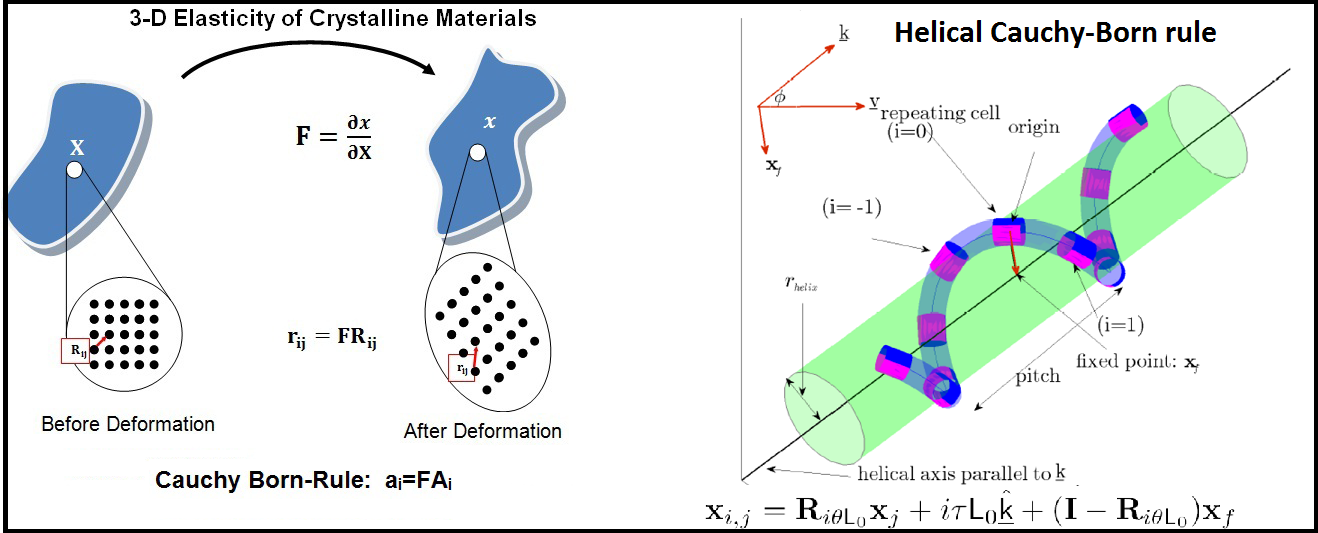
Multiscale modeling of one-dimensional nanostructures - Helical Cauchy-Born rule Constitutive modeling of materials is a key area of research in solid mechanics. Often strains applied are so large that one is interested in accurate nonlinear relation between stress and strain tensors. These relations for a given material can be obtained from its atomic-and micro-level structures and how these structures adapt to imposed macroscopic deformations. This insight provides us with a tool to predict nonlinear continuum response of materials which is broadly called Multiscale modeling of materials. The bridging between atomic-level information and continuum level constitutive response is facilitated using the Cauchy-Born (CB) rule. This rule in its original form, however, is useful to obtain three-dimensional nonlinear elastic constitutive relations. Our research group has proposed a novel Helical CB rule to facilitate this bridging for modeling one-dimensional nanostructures (e.g., Carbon nanotubes, DNA, biomolecules, polymers etc.) as a one-dimensional continuum rod. The basic idea is that the role of translational symmetry in the standard CB rule is replaced with a 6-parameter helical symmetry in the proposed helical CB rule. An illustration of the helical CB rule is depicted in the adjacent figure. An explicit formula for the 6-parameter helical map is derived which maps atoms in the repeating cell of a nanorod to their images for the purpose of repeating cell energy minimization. The scheme allows one to obtain all the stiffnesses (bending, twisting, extensional and shearing) of a nanorod modeled as a special Cosserat rod. We show it to be more general and accurate than existing schemes. In fact, shearing stiffness and several coupling stiffnesses of a nanorod can now be obtained for the first time. Ajeet Kumar, Siddhant Kumar, Prakhar Gupta, A Helical Cauchy-Born rule for special Cosserat rod modeling of nano and continuum rods, Journal of Elasticity, 124 (2016), 81-106 |
|
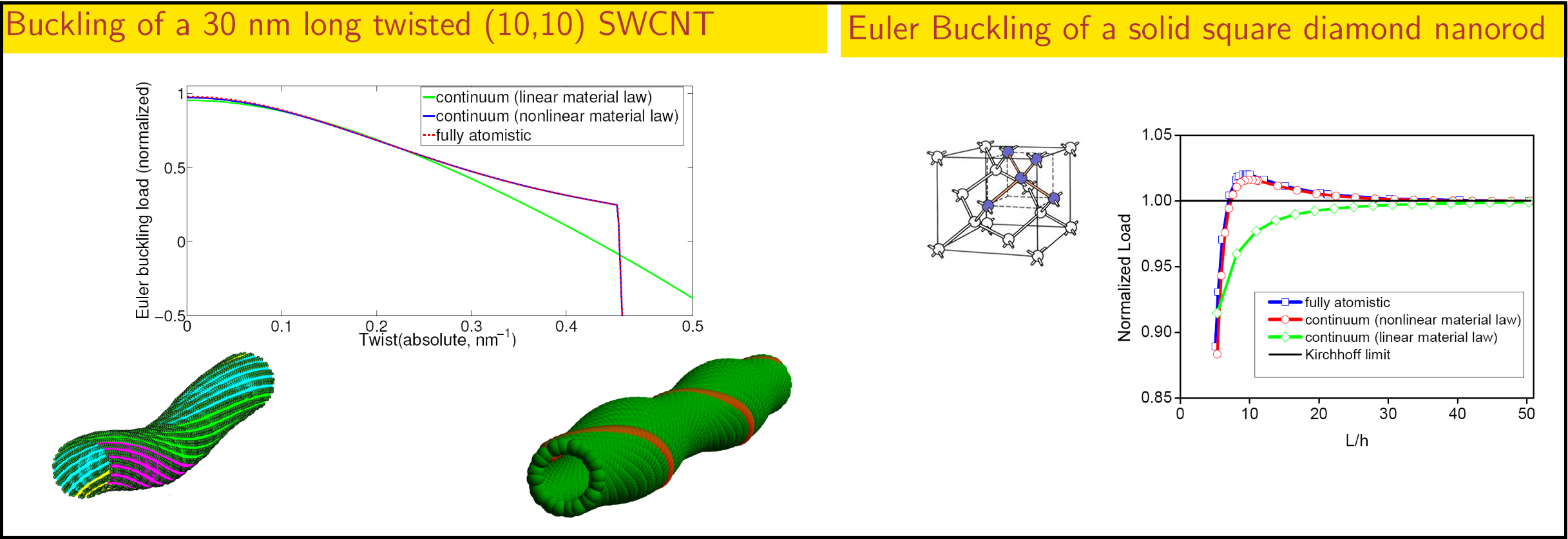
Accurate determination of buckling of nanorods and nanotubes using continuum formulation Using the helical Cauchy-Born rule, we have been able to accurately estimate buckling load of carbon nanotubes and diamond nanowires in a continuum framework. The nanotube or nanorod was modeled as a special Cosserat rod at continuum level whose nonlinear stiffnesses were obtained using the helical Cauchy-Born rule. Finite element simulations were further performed to obtained the buckled solution. The verification of the buckling load as well as the buckled configurations were done by comparing with fully-atomistic simulation results as shown in the adjacent figure. The use of continuum models (in particular, one-dimensional Cosserat rod model) for predicting mechanical behavior of nanostructures is quite attractive since the computational cost involved is much cheaper compared to fully atomistic calculation.
|
|
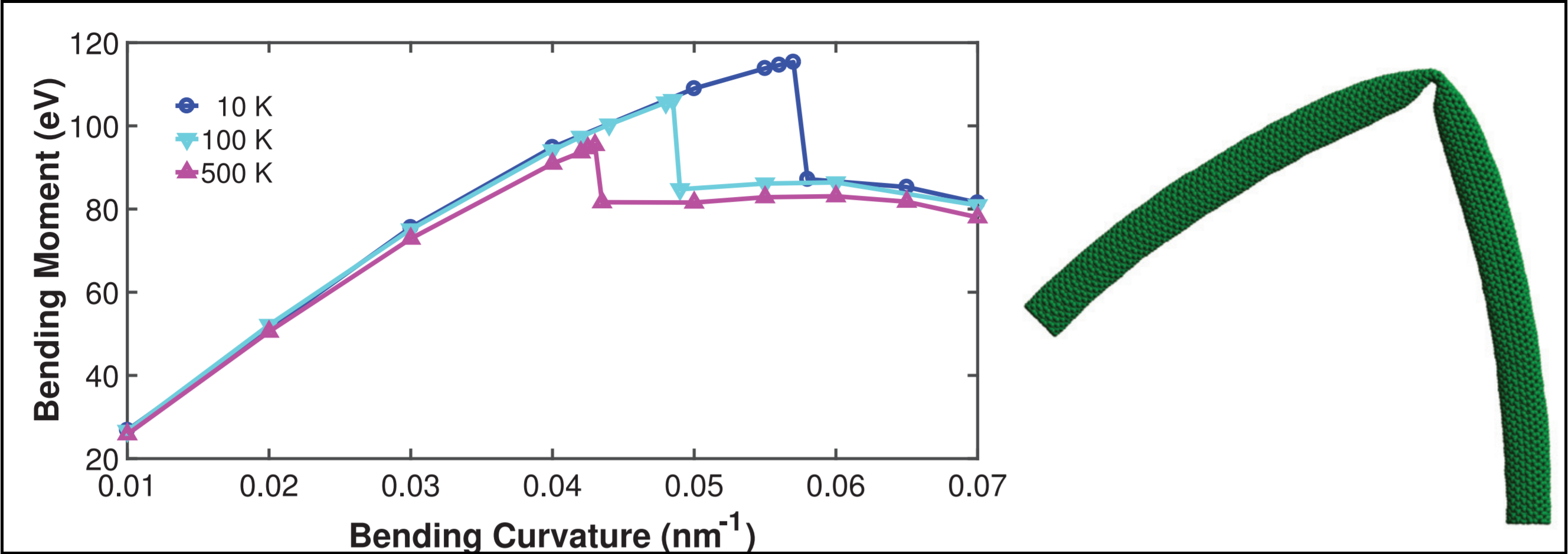
Thermoelasticity of one-dimensional nanostructures using a modified Irving-Kirkwood-Noll formulation A one-dimensional variant of the Irving–Kirkwood–Noll procedure is derived to obtain microscopic expressions of internal contact force and moment in one-dimensional nanostructures. We show that these expressions must contain both the potential and kinetic parts: just the potential part does not yield meaningful continuum results. We further specialize these expressions for helically repeating one-dimensional nanostructures for their extension, torsion, and bending deformation. As the Irving–Kirkwood–Noll procedure does not yield expressions of stiffnesses, we resort to a thermodynamic equilibrium approach to first obtain the Helmholtz free energy of the supercell of helically repeating nanostructures. We then obtain expressions of axial force, twisting moment, bending moment, and the associated stiffnesses by taking the first and second derivatives of the Helmholtz free energy with respect to conjugate strain measures. The derived expressions are used in finite-temperature molecular dynamics simulation to study extension, torsion, and bending of single-walled carbon nanotubes and their buckling. Smriti, Ajeet Kumar, Microscopic definition of internal force, moment and associated stiffnesses in one-dimensional nanostructures at finite temperature, Mathematics and Mechanics of Solids, 25 (2020), 986-1010.
|
|
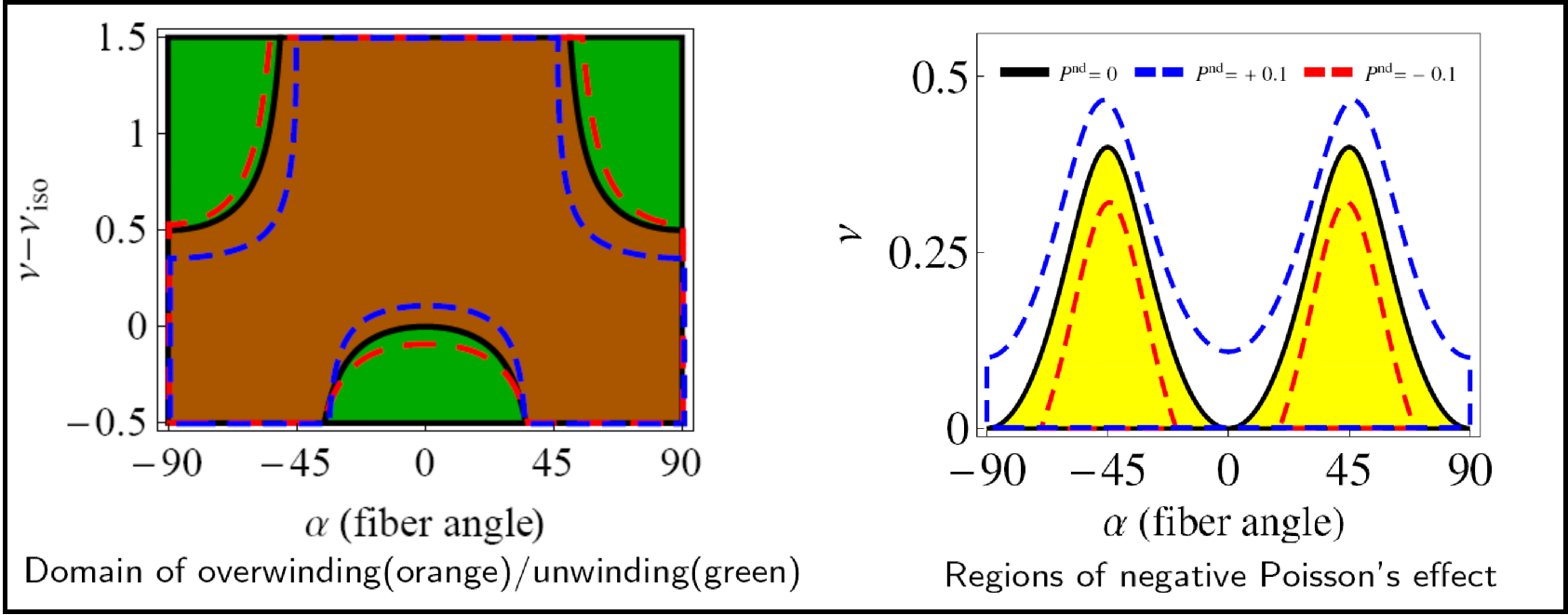
Unusual extension-torsion-inflation couplings (negative Poisson's ratio, Poynting effect, overwinding-unwinding) in elastic tubes: effect of mechanical pressure, magnetic and electric field An axisymmetric and axially homogenous variational formulation is presented for coupled extension-torsion-inflation deformation in compressible tubes in the presence of mechanical pressure or electric/magnetic field. The tube’s material is assumed to have a preferred direction of anisotropy (either elastic or magnetic/electric poling) which lies in the radial plane but directed at an angle from the tube’s axial direction - this imparts helical anisotropy to the tube. The governing differential equations necessary to solve the above deformation problem are obtained which are shown to reduce to a set of nonlinear algebraic equations in the thin tube limit. This allows us to obtain analytical expressions in terms of the applied pressure or magnetic/electric field, anisotropic direction and magneto-electro-elastic constants which tell us how these parameters can be tuned to generate unusual coupled deformations such as the negative Poisson’s effect or unusual overwinding/unwinding behavior. The study can be useful in designing magnetoelastic/ electroelastic soft tubular actuators. 1. Darius Diogo Barreto, Ajeet Kumar, Sushma Santapuri, Extension-torsion-inflation coupling in compressible magnetoelastomeric thin tubes with helical magnetic anisotropy, Journal of Elasticity, 140 (2020), 273-302 2. Shashank Saxena, Darius Diogo Barreto, Ajeet Kumar, Extension-torsion-inflation coupling in compressible electroelastomeric thin tubes, Mathematics and Mechanics of Solids, 25 (2020), 644-663 3. Raushan Singh, Pranjal Singh, Ajeet Kumar, Unusual extension-torsion-inflation couplings in pressurized thin circular tubes with helical anisotropy, Mathematics and Mechanics of Solids, 24 (2019), 2694-2712 4. Raushan Singh, Siddhant Kumar and Ajeet Kumar, Effect of intrinsic twist and orthotropy on extension-twist-inflation coupling in compressible circular tubes, Journal of Elasticity, 128 (2017), 175-201 |
|
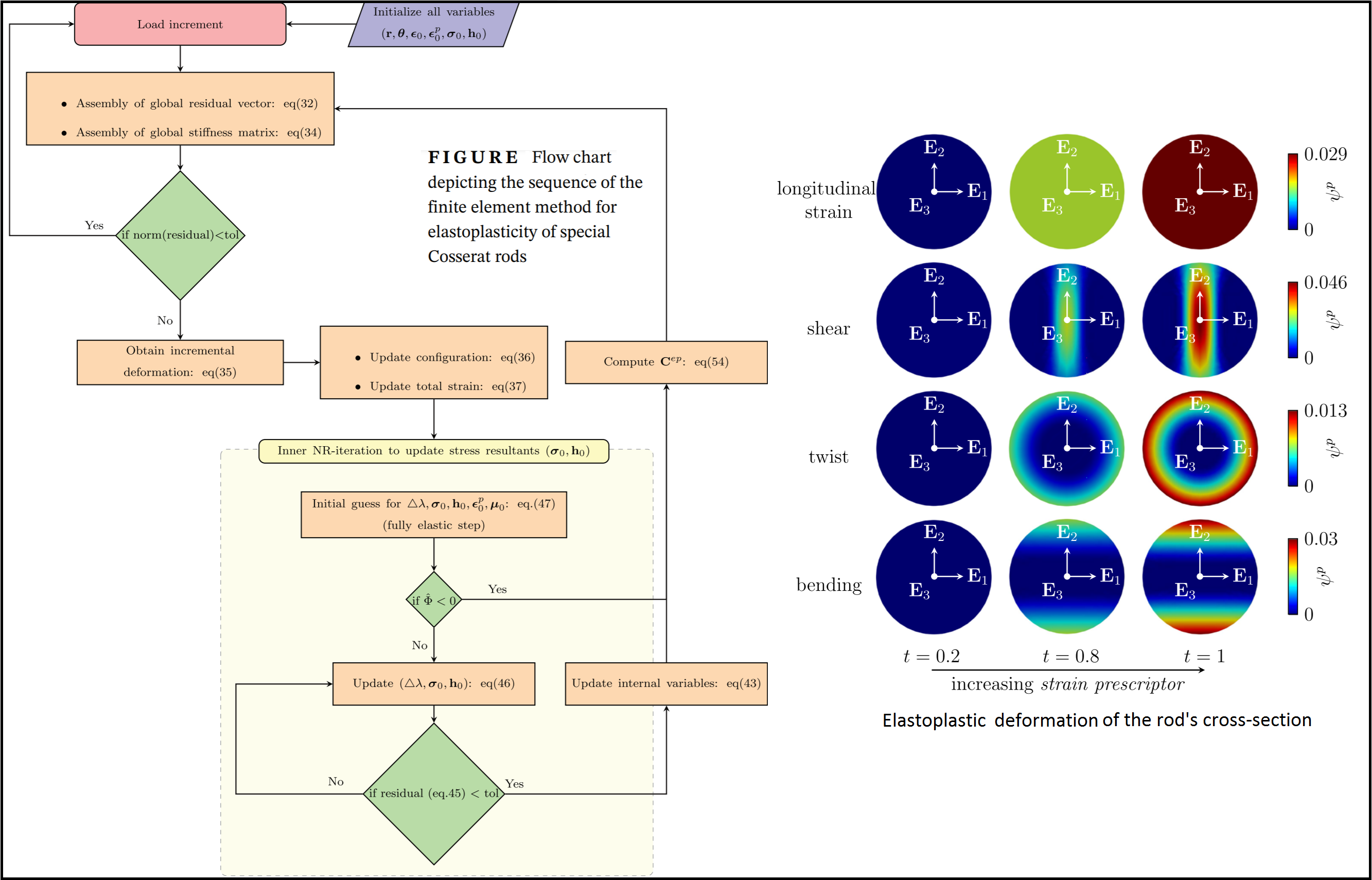
Incorporating plasticity within the theory of Cosserat rods The three-dimensional theory of finite deformation elastoplasticity is applicable to bodies having arbitrary shape. However, a rod-like finite deformation elastoplastic theory suitable for slender structures did not exist. In this regard, a general theory has been developed by our group to incorporate elasto-plastic deformations within the framework of the special Cosserat rod theory. The theory has additional plastic strain and hardening variables, which are functions of just the rod’s arc-length, to account for plastic deformation of the rod. Furthermore, the theory assumes the existence of an effective yield function in terms of stress resultants, i.e., force and moment in the cross-section and cross-section averaged hardening parameters. An associative flow rule is also proposed for the evolution of the rod's plastic strain measures and hardening variables. Furthermore, a finite element (FE) formulation has been developed for the developed theory. A limitation of the proposed framework is that it assumes the existence of an effective yield function in terms of the rod's internal force and moment. For the accurate determination of such a yield function, the use is made of a formulation (i.e., Helical Cauchy-Born rule) wherein the rod is subjected to an uniform strain field along its arc length, thereby reducing the elastoplastic problem of the full rod to just its cross-section. By integrating the plastic work and the stresses over the rod’s cross-section, one then obtains discrete points of the yield surface in terms of stress resultants. Eventually, Lam� curves in their most general form are fitted to the discrete points by an appropriate optimization method to obtain an analytical form of the effective yield function. 1. Ludwig Herrnbock, Ajeet Kumar, Paul Steinmann, Two-scale off- and online approaches to geometrically exact elastoplastic rods, Computational Mechanics (doi: 10.1007/s00466-022-02204-8) 2. Ludwig Herrnbock, Ajeet Kumar, Paul Steinmann, Geometrically exact elastoplastic rods – determination of yield surface in terms of stress resultants, Computational Mechanics, 67 (2021), 723-742 3. Smriti, Ajeet Kumar, Paul Steinmann, A finite element formulation for a direct approach to elastoplasticity in special Cosserat rods, International Journal of Numerical Methods in Engineering, 122 (2021), 1262-1282 4. Smriti, Ajeet Kumar, Alexander Grobmann, Paul Steinmann, A thermo-elasto-plastic theory for special Cosserat rods, Mathematics and Mechanics of Solids, 24 (2019), 686-700.
|
|
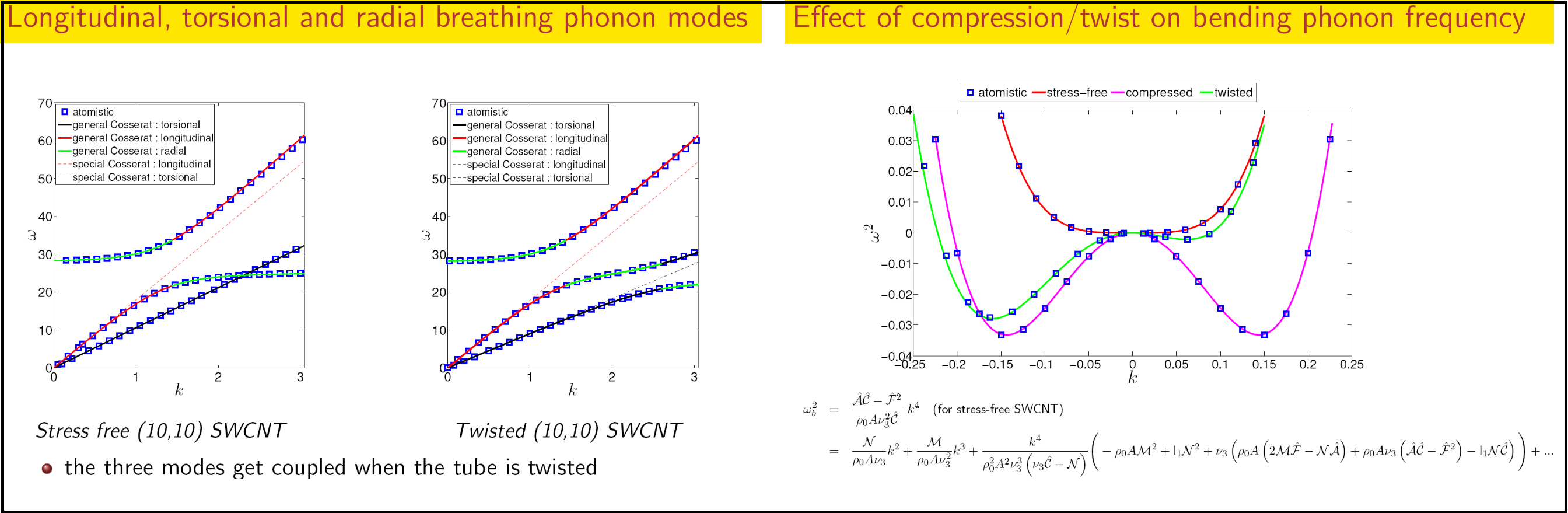
Modulating phonon-dispersion behavior of carbon nanotubes through their extension and torsion A Cosserat-rod-based continuum approach is derived to obtain phonon dispersion curves of flexural, torsional, longitudinal, shearing, and radial breathing modes in chiral nanorods and nanotubes. Upon substituting the continuum wave form in the linearized dynamic equations of stretched and twisted Cosserat rods, we obtain an analytical expression of a coefficient matrix (in terms of the rod’s stiffnesses, induced axial force, and twisting moment) whose eigenvalues and eigenvectors give us frequencies and mode shapes, respectively, for each of the above phonon modes. We show that, unlike the case of achiral tubes, these phonon modes are intricately coupled in chiral tubes owing to extension–torsion–inflation and bending–shear couplings inherent in them. This coupling renders the conventional approach of obtaining stiffnesses from the long wavelength limit of dispersion curves redundant. However, upon substituting the frequencies and mode shapes (obtained independently from phonon dispersion molecular data) in the eigenvalue–eigenvector equation of the above-mentioned coefficient matrix, we are able to obtain all the stiffnesses (bending, twisting, stretching, shearing, and all coupling stiffnesses corresponding to extension–torsion, extension–inflation, torsion–inflation, and bending–shear couplings) of chiral nanotubes. We show in the adjacent figure some unusual effects of the single-walled carbon nanotube’s chirality as well as stretching and twisting of the nanotube on its phonon dispersion curves. Prakhar Gupta, Ajeet Kumar, Phonons in chiral nanorods and nanotubes: a Cosserat rod based continuum approach, Mathematics and Mechanics of Solids, 24 (2019), 3897-3919 |
|
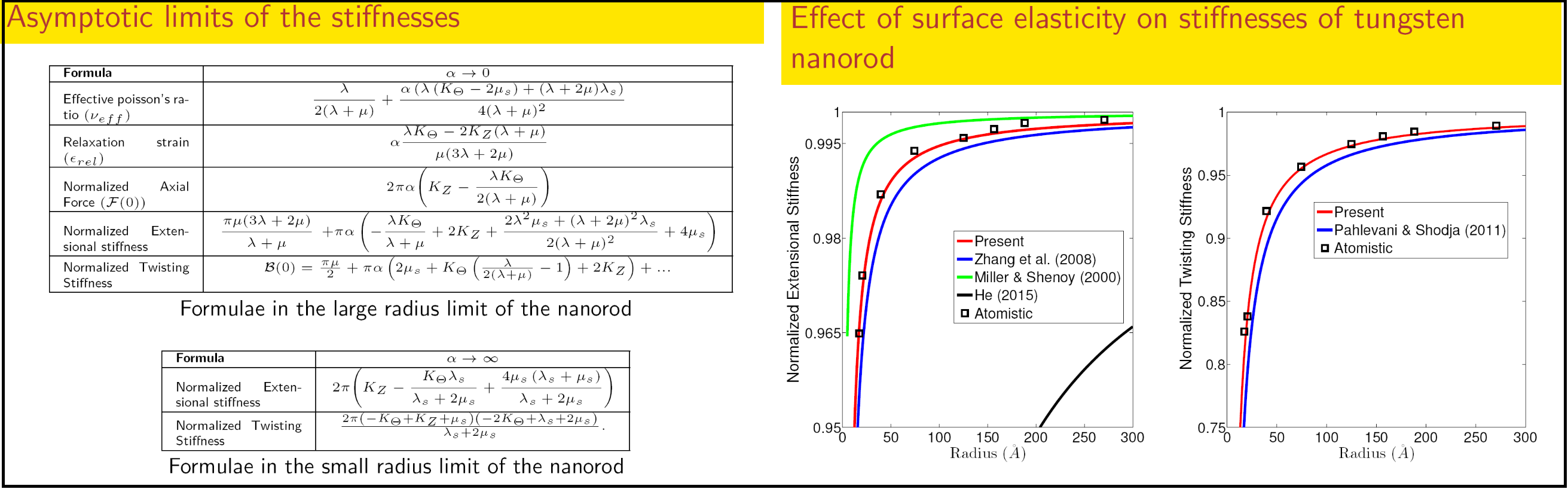
Extensional and torsional stiffnesses of circular nanorods - incorporating the effect of surface elasticity A continuum formulation is derived to obtain the effects of surface residual stress and surface elastic constants on extensional and torsional stiffnesses of isotropic circular nanorods. Analytical expressions of axial force, twisting moment, and extensional and torsional stiffnesses are obtained. Unlike the case of rectangular nanorods, we show that the stiffnesses of circular nanorods also depend on surface residual stress components. This is attributed to non-zero surface curvature inherent in circular nanorods. We further normalize these expressions and analyze their asymptotic limits in the limit of the nanorod’s radius approaching both zero and infinity, corresponding to surface-dominated and bulk dominated regimes, respectively. Finally, we use the helical Cauchy–Born rule and perform molecular statics calculations to obtain axial force, twisting moment, and stiffnesses of the tungsten nanorod. The results from molecular statics calculations match accurately with the derived continuum formulas as illustrated in the adjacent figure. Prakhar Gupta, Ajeet Kumar, Effect of surface elasticity on extensional and torsional stiffnesses of isotropic circular nanorods, Mathematics and Mechanics of Solids, 24 (2019), 1613-1629 |
|
|
|
|
|