Research
We use atomistic simulation techniques, mainly classical molecular dynamics and Monte Carlo methods. We also work on quantum Monte Carlo methods, particularly the Fourier path integral approach for simulating finite temperature quantum clusters, liquids and solids.
- Structure, Entropy and Transport Relationships in Liquids
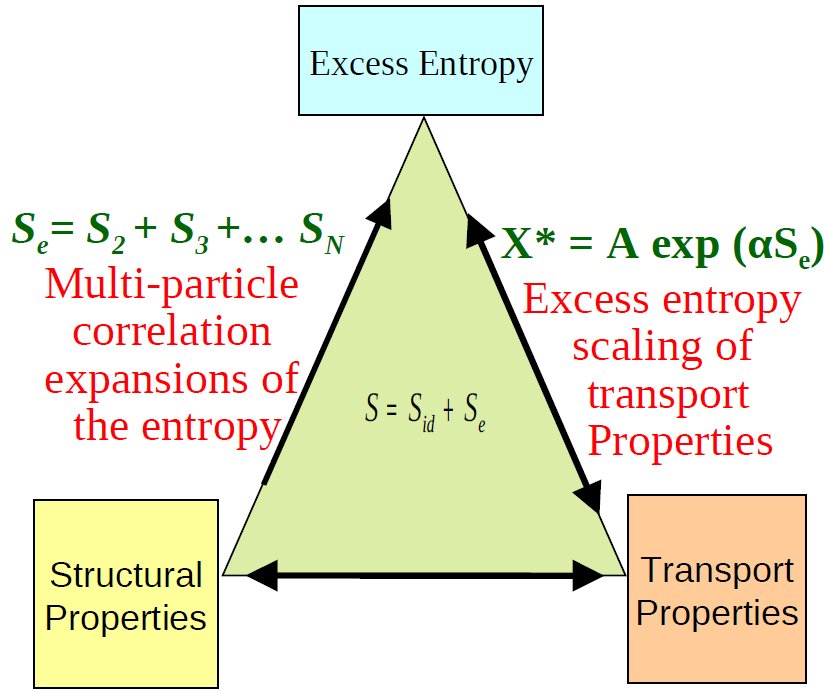
We have been interested in developing relationships between structural, thermodynamic and dynamic properties of liquids, using the excess entropy of a fluid as a central quantity that can be related to structural correlations as well as transport properties. The excess entropy is defined as the entropy of a fluid relative to that of the ideal gas at the same temperature and density. The multiparticle correlation expansion of the entropy allows one to decompose the excess entropy of a fluid into contributions from pair and higher-order correlation terms. Since the atom-atom pair correlation function can be accessed from scattering experiments as well as simulations, the pair entropy is a convenient structural estimator of the entropy. A semiquantitative exponential dependence of reduced transport properties, such as the diffusivity, viscosity and thermal conductivity, on the excess entropy was predicted originally by Rosenfeld for simple liquids. We have demonstrated that such relationships hold for a much wider class of liquids, including chain fluids, ionic melts, alkanes and water. The breakdown of Rosenfeld-scaling relationships is associated with onset of cooperative dynamics. The combination of multiparticle correlation expansion of the entropy, and Rosenfeld scaling has been very useful in a number of contexts; for example, connecting structural, thermodynamic and mobility anomalies of water, relating network formation, viscosity and ionic conductivity in ionic melts and understanding time scale changes associated with coarse graining. By studying the competition between pair and triplet contributions to the entropy , we can understand the transformation of simple liquids to complex, tetrahedral liquids. In a recent study, we consider the possibility of extending these ideas to fluids confined in micro- and meso-porous materials, such as zeolites.
- Water and Water-like Liquids
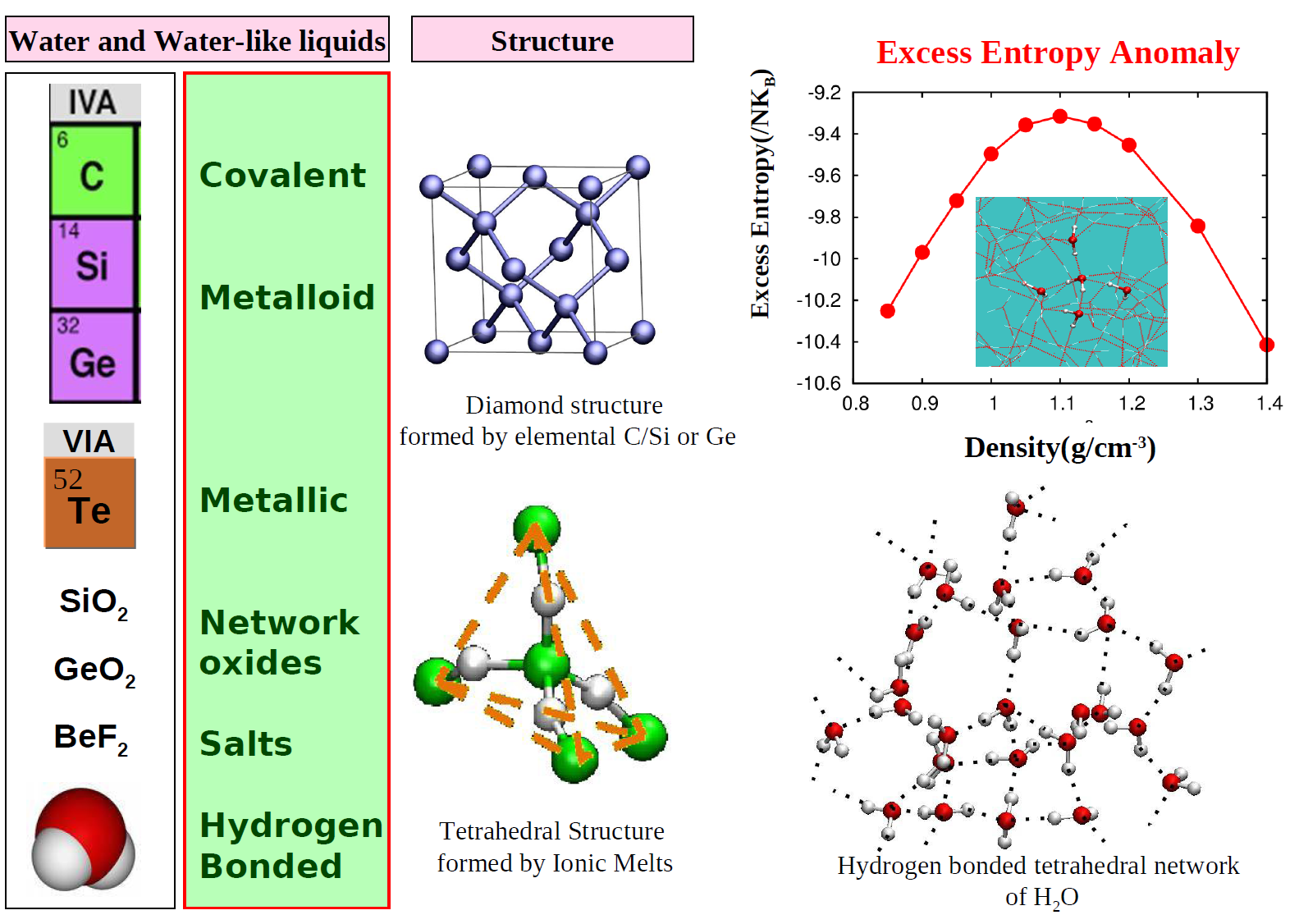
Water, despite its familiarity, does not fit the description of a simple liquid. The anomalous thermodynamic behaviour is evident even under ambient conditions, with a decrease in molar volume of 8.3% on melting at 273.15 K. The other well-known anomaly is the rise in density on isobaric heating, with a temperature of maximum density (TMD) of 277.15 K at 1 atm. In contrast, isobaric heating results in decreasing density in a simple liquid. The dynamic anomalies of water are associated with a rise in molecular mobility on isothermal compression , as measured by diffusivity, viscosity or reorientational times. In contrast, in simple liquids, compression reduces mobility due to increasing steric hindrance. The thermodynamic and mobility anomalies of water are, however, not unique to water but are found in liquids with very diverse types of interactions, such as other liquids with a tetrahedral network structure (molten silica and silicon), as well as p-bonded metallic liquids, such a tellurium or tellurium alloys, and mesoscopic fluids with core-softened or finite interparticle repulsion. The characteristic feature of this family of liquids with water-like anomalies is a density-driven shift in the nature of local order, we discuss how this order parameter description of water-like liquids. Using the quantitative connections between mobility, entropy and structural order, we can show that the critical feature of such fluids is an excess entropy anomaly, corresponding to a rise in excess entropy on isothermal compression. We are interested in detailed simulation studies of bulk water, aqueous solutions as well as a range of water-like liquids. Another aspect of water that we have been interested in is the quantitative characterization of the multiple time-scale behaviour dynamics in water and other network-forming liquids.
- Biomolecular Hydration
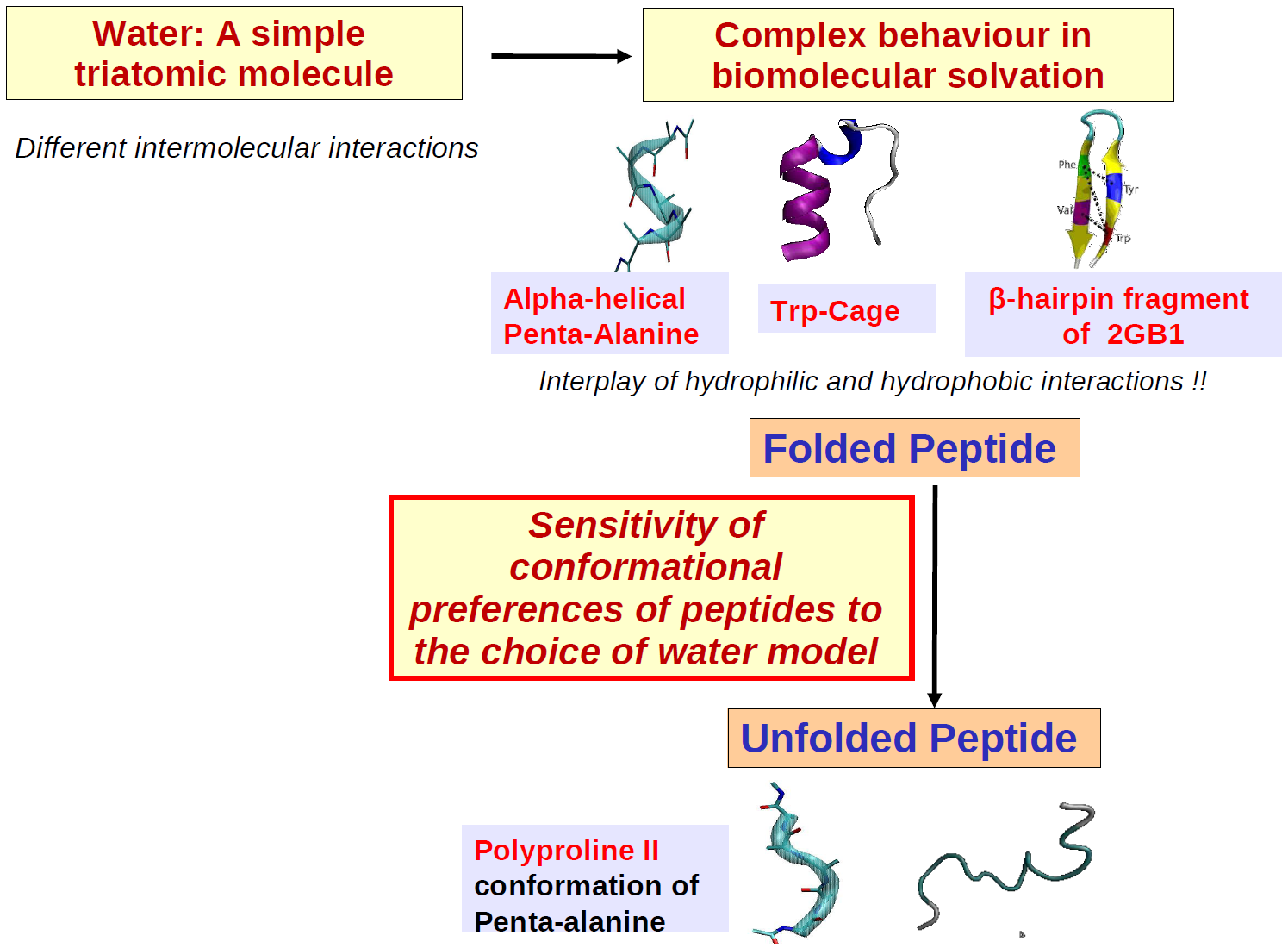
The three-dimensional structure and function of biomolecules depend on the aqueous solvation environment of living cells. In the case of proteins, the interplay of hydrophilic and hydrophobic solvation of the side-chains is crucial in determining the secondary and tertiary structures. We are interested in understanding the physics underlying the hydration of simple solutes is still an active area of research, particularly with a view to designing accurate, transferable and computationally efficient potential energy surfaces to model hydration of biomolecules. Standard biomolecular force-fields (GROMOS, AMBER, CHARMM) have typically been designed to reproduce structural data from crystallographic or NMR studies under ambient conditions. Such force-fields use either implicit solvent models or explicit solvent models based on standard rigid-body, pair-additive models of water. Interestingly, our work as well as those of others demonstrates hat rigid-body water models differ widely in their predictive ability with regard to liquid-state anomalies, equations of state and phase diagrams of bulk water. We are interested in examining the consequences of specific choices of solvent models on biomolecular solvation, at the level of local hydration shell structure, energetics and dynamics. We are also interested in mapping out how these relatively small differences in hydration translate into a significant dependence of the conformational free energy landscape, particularly the folding–unfolding equilibria, on the choice of water models.
- Nanoparticle Assembly
In order to use nanoparticles in applications, it is necessary to assemble them into relatively high-density, ordered or amorphous, arrays. Experimentally, self-assembly of nanoparticles from stable dispersions under equilibrium or non-equilibrium conditions, is one of the most effective ways to create ordered two- and three-dimensional assemblies. The chemical and physical aspects of the nanocrystal-ligand-solvent system pay a crucial role in determining the thermodynamics and kinetics of the self-assembly process. We are interested in developing simulation strategies to model and understand the self-assembly of ordered structures of nanoparticles, with applications to ligand-passivated metal and semiconductor nanoparticles.
Solvation of Nanoparticles
Understanding how structural reorganization of the solvent in the neighbourhood of a nanoscale solute, such as ligand-passivated nanoparticle, can be related to the thermodynamic parameters for solvation in the infinite dilution limit
Relating Structure, Entropy and Energy of Solvation of Passivated Metal Nanoparticles
Divya Nayar, Hari Om Sharanam Yadav, B. Shadrack Jabes and Charusita Chakravarty
Journal of Physical Chemistry, 116, 13124 (2012)
Anisotropic pair interactions due to ligand-shell fluctuations of nanoparticles
Fluctuation-Driven Anisotropic Assembly in Nanoscale Systems
Behnaz Bozorgui, Dong Meng, and Sanat K. Kumar, Charusita Chakravarty, Angelo Cacciuto
Nano Letters, 13, 2732 (2013)
- Phase Transitions
The most common phases of matter are solid, liquid and gas. A phase transition is a sharp change in the collective or thermodynamic behaviour of a system; for example, when ice melts or water vapour condenses to form clouds. We are interested in using computer simulation techniques to understand the molecular basis of phase transitions and phase transformation kinetics, particularly with respect to melting/crystallization and self-assembly phenomena. We have been interested in computing Landau free energy curves for melting for both classical and quantum solids. We have been interested in cluster analogues of bulk phase transition, such as melting and binary segregation of isotopic mixtures.
- Potential Energy Landscapes of Clusters, Liquids and Solids
One route to understand the connection between atomic level interactions and collective features of a many-atom system, such as a phase transition, is to consider qualitative and quantitative features of the corresponding energy landscape. The potential energy of an interacting collection of atoms is a complex function of the multidimensional configurational space and in principle contains information necessary to understand the collective properties. The energy landscape approach focuses on specific topographic features of this function, such as local minima, maxima and saddle points. We have been interested in studying the energy landscapes of simple and anomalous fluids, as well as in relating landscape features to the thermodynamic and kinetic aspects of melting and freezing transitions.
- Path Integral Monte Carlo Methods
The path integral Monte Carlo methods allow for simulation of quantum many-body systems at finite temperatures. A number of different computational implementations of the path integral formalism are possible. Two commonly used representations of the path integral are the Fourier path integral approach (in which the contributing paths are expressed as a linear combination of fluctuations in imaginary time with different length scales) and the discretised path integral approach (in which the paths are expressed as coordinates at discrete equidistant points in imaginary time). My work in this area has focused on developing the Fourier path integral method as a convenient algorithm for simulating atomic and molecular systems which provides sufficient accuracy for configurational properties and is at the same time, simple enough to be readily adapted for a range of systems and ensembles. A recent study makes a detailed comparison of the efficiencies of the discretised and Fourier path techniques for molecular clusters. The Fourier path integral approach has also been adapted for simulations in the isothermal-isobaric ensemble as well as to perform free energy estimations using an umbrella sampling strategy. An ab initio path integral Monte Carlo method which combines a path integral description for the nuclear degrees of freedom with a density functional treatment of the electronic structure has been developed in collaboration with an electronic structure group. Such AIPI methods are useful for problems where there are appreciable quantum effects due to light nuclei and a parametric representation of the potential energy surface is not possible. Our initial application was to lithium clusters and we plan to study a wider range of problems with this technique in the future.
- Quantum Clusters
I have been interested in studying analogues of bulk phase transitions in small quantum clusters. This has included the study of structural and thermodynamic properties of specific quantum clusters as well as more general features of cluster phase transitions. For example, isotopically mixed quantum clusters are predicted to show a purely quantum analogue of binary phase segregation. While my study was based largely on simulations of mixed H2/D2 clusters, experimental studies by the group of Toennies at Gottingen have demonstrated this effect in 3He/4He clusters. Another set of studies has been on quantum effects on cluster melting, in which a cluster makes a transition from a rigid, solid-like state localised in the global minimum to a non-rigid, liquid-like state. I have also explored the applicability of inherent structure and instantaneous normal mode ideas to quantum clusters.
- Phase Equilibria in Quantum and Classical Systems
Quantum effects are known to significantly affect the phase diagram of a substance, for example, by lowering phase coexistence temperatures. Using our path integral Monte Carlo adaptation of existing classical Monte Carlo schemes to generate Landau free energy curves, I have been studying quantum effects on bulk melting. Our method can be used to explore a range of simple solids with varying quantum character, starting with quasiclassical systems like Neon to strongly quantum systems such as bulk para-H2 under constant pressure-temperature conditions. In a study of quantum Lennard-Jones systems, we have demonstrated a systematic decrease in melting temperature with increasing degree of quantum delocalisation and found that our predictions for molecular hydrogen and its isotopomers agree reasonably well with experiment. In some of my recent work, I have been studing the connection between generic features of the interatomic potential and the phase diagram for classical systems.The nature and stability of the liquid phase is known to be very sensitive to the attractive component of the interatomic potential. I am currently examining changes in the phase diagram for pair-additive Morse systems as a function of the range of the interatomic interaction. Studies on energy landscapes of Morse clusters indicate that the underlying topography of the potential energy landscape changes substantially with the range of interaction and therefore studies of the bulk solid and liquid may be useful from the point of view of inherent structure and instantaneous normal mode approaches to liquid state properties and phase transitions.
- Adsorption and Diffusion in Zeolites
Confinement of fluids in an ordered, porous medium can lead to interesting variations in diffusional behaviour which can be controlled by modifying both the sorbent (zeolite) architecture as well as by varying the properties of the sorbate. My current interest is to understandthe properties of sorbates and how by varying the size, polarizability and quantum character of simple sorbates, one can understand unusual patterns in diffusional behaviour such as the levitation effect and single-file diffusion. To do this, one of the tools I have successfully employed is instantaneous normal mode (INM) analysis which was originally developed to understand short-time dynamics in bulk liquids. Since the confining medium significantly affects the potential energy landscape of the fluid, it is natural that the INM spectra should carry signatures of changes in the short-time dynamical behaviour of fluids on confinement. I have also looked at quantum effects on adsorption of helium in silicalite.
- Dynamical Behaviour of Clusters
For classical systems, the microcanonical molecular dynamics method provides a way to simulate the many-body dynamics. Concepts from the areas of non-linear dynamics and chaos can the be used to analyse and understand this dynamics. For example, one can quantify the sharp increase in chaotic behaviour associated with cluster melting using the maximal Lyapunov exponent as an order parameter. More interestingly, one can show that clusters in the solid-liquid coexistence regime show a 1/f-dependence in the power spectrum of potential energy fluctuations indicative of multiple time-scales and complex dynamics.
Triplet correlations dominate the transition from simple to tetrahedral liquids
Murari Singh, Debdas Dhabal, Andrew Huy Nguyen, Valeria Molinero, and Charusita Chakravarty
Physical Review Letters, accepted (2014)
Structural Correlations and Cooperative Dynamics in Supercooled Liquids
Murari Singh, Manish Agarwal, Debdas Dhabal and Charusita Chakravarty
Journal of Chemical Physics, 137, 024508 (2012)
Relating Composition, Structural Order, Entropy and Transport in Multi-component Molten Salts
B. Shadrack Jabes and Charusita Chakravarty
Journal of Chemical Physics, 136, 144507 (2012)
Statistical mechanics of coarse graining: estimating dynamical speed-ups from excess entropies
J. A. Armstrong, C. Chakravarty and P. Ballone
Journal of Chemical Sciences, 136, 124503 (2012)
Transport in Nanoporous Zeolites: Relationships between Sorbate Size, Entropy and Diffusivity
Bhaskar J. Borah, Prabal K Maiti, Charusita Chakravarty and S. Yashonath
Journal of Chemical Physics, 136, 174510 (2012)
Transport Properties of Tetrahedral, Network-Forming Ionic Melts
Manish Agarwal, Abir Ganguly and Charusita Chakravarty
Journal of Physical Chemistry B, 113, 115284 (2009)
Excess entropy scaling of transport properties of Lennard-Jones chains
Teena Goel, Chandra Nath Patra, Tulsi Mukherjee and Charusita Chakravarty
Journal of Chemical Physics, 129, 164904 (2008)
Water and water-like liquids: relationships between structure, entropy and mobility
Divya Nayar and Charusita Chakravarty
Physical Chemistry Chemical Physics, 15, 1416 (2013)
Thermodynamic, Diffusional, and Structural Anomalies in Rigid-Body Water Models
Manish Agarwal, Mohammad Parvez Alam, and Charusita Chakravarty
Journal of Physical Chemistry B, 115, 6935 (2011)
Entropy, diffusivity and structural order in liquids with waterlike anomalies
Ruchi Sharma, Somendra Nath Chakraborty and Charusita Chakravarty
Journal of Chemical Physics, 125, 204501 (2006).
Entropy, local order, and the freezing transition in Morse liquids
Somendra Nath Chakraborty and Charusita Chakravarty
Physical Review E, 76, 011201 (2007)
Lindemann measures for the solid-liquid phase transition
Charusita Chakravarty, P. G. Debenedetti and F. H. Stillinger
Journal of Chemical Physics, 126, 204508 (2007).
Landau free energy curves for melting of quantum solids
C. Chakravarty and R. M. Lynden-Bell
Journal of Chemical Physics, 113, 9239-9247 (2000).
Structure of Binary Quantum Clusters
C. Chakravarty
Physical Review Letters, 75, 1727-1730 (1995).
Entropy, diffusivity and the energy landscape of a waterlike fluid
Alan Barros de Oliveira, Evy Salcedo, Charusita Chakravarty, and Marcia C. Barbosa
Journal of Chemical Physics, 132, 234509 (2010)
Lindemann measures for the solid-liquid phase transition
Charusita Chakravarty, P. G. Debenedetti and F. H. Stillinger
Journal of Chemical Physics, 126, 204508 (2007).
Potential Energy Landscapes of Simple Liquids
Pooja Shah and Charusita Chakravarty
Physical Review Letters, 88, 255501-1 to 255501-4 (2002).