A n A l g o r i t h m i c
The Problem
With the increasing number of potential coronavirus patients every day, it is the need of the hour to employ rapid testing methods and it’s extremely important to do this in an economical manner.
The country is facing a huge shortage of testing kits and the current scenario is such- for every potential carrier, one test is done to test whether the person is negative or positive for the virus. This means, to be able to classify every person in a group of 100 people as positive or negative for the virus, we end up using 100 testing kits. This isn’t efficient considering that the number of patients that need to be tested every day is extremely higher than the number of testing kits available.
Binary Search To The Rescue
Here’s a proposed binary search algorithm to test a group of 100 people using less than 100 testing kits.
Consider a group of 100 isolated people of which 5 are infected (Current Situation — 5 people test positive for every 100 people tested in India).
Let’s say we’re able to mix samples from a hundred people together into one large sample (say, sample X) and we test this sample X for the virus. If it tests negative, we can declare that there are no infected people in the group. If the sample tests positive, we can say there’s at least one infected person in the group.
Since our example assumes 5 infected patients, the sample X tests positive.
Now, we divide this group of 100 people into two groups of 50 each and test samples Y (group 1 of size 50) and Z (group 2 of size 50) for the virus. If the samples test positive, we break down the group again to continue testing and if it tests negative we let the group go and declare them as a safe group.
The illustration helps us visualize the number of tests needed to check every person for the virus in a group of 100 people. A red circle denotes a group with at least one infected person and a green circle denotes a healthy and safe group of individuals.
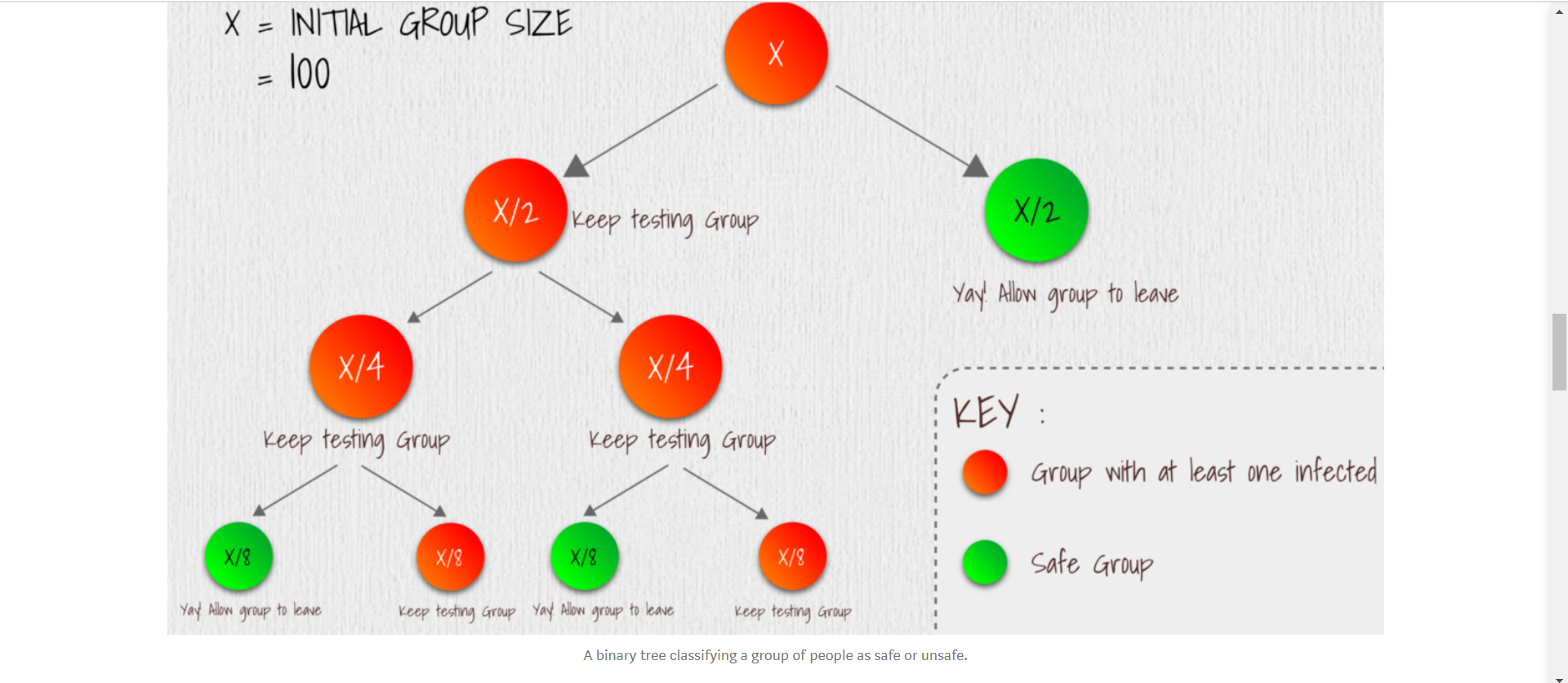
At level 1, we test 1 group of a hundred people. At level 2 we test two groups of 50 people each. At level 3, we test 4 groups of 25 each and for the subsequent levels, we only have to test a maximum of 5 groups that are still red in color (since it is assumed that only 5 people are infected in total, so at any given level the maximum number of groups that will show the certainty of being infected is 5). For every group that we test at each level, we need one testing kit per group
For every new level of people, we start closing upon the groups that contain infected patients and start eliminating groups that don't.
We go a maximum of 7–8 levels deep before we can exactly pinpoint the infected people in a group of 100 people. What’s the total number of testing kits used?
Summing up kits used at each level, 1+2+4+5+5+5+5+5 = 32.
Reference
The concept of group testing was first introduced by Robert Dorfman in 1943 in a short report published in the Notes section of Annals of Mathematical Statistics.[3][b] Dorfman's report – as with all the early work on group testing – focused on the probabilistic problem, and aimed to use the novel idea of group testing to reduce the expected number of tests needed to weed out all syphilitic men in a given pool of soldiers. The method was simple: put the soldiers into groups of a given size, and use individual testing (testing items in groups of size one) on the positive groups to find which were infected. Dorfman tabulated the optimum group sizes for this strategy against the prevalence rate of defectiveness in the population
Here is Research Paper Developed by Cassidy Mentus, Martin Romeo and Christian DiPaola about this alogorithmic approach for testing in detail.
As far as it's practical application goes some sources say that Germany has implemented this method and saw a tremendous growth in their testing pace. I found this article on Reddit where they claim the adoption of this approach.