Minimal Complexity Machines
Learning small models by minimizing smooth differentiable upper bounds related to the VC dimension.
AI, Swarm Intelligence, VLSI
Our work formulates new theoretical models for significant hurdles, develops applications around them, and realizes selected ideas on silicon.
Focus
The focus of our work has been to formulate new theoretical models that address significant hurdles, develop new applications around them, and, for selected applications, realize them on silicon.
The website presents selected milestones across learning small models, imbalanced datasets, hashing, graph coarsening, swarm intelligence, healthcare, material properties, and adaptive analog circuits.
This webpage has been designed and maintained by Prof. Jayadeva's students.
Theory
Learning small models by minimizing smooth differentiable upper bounds related to the VC dimension.
Learning two non-parallel hyperplanes for imbalanced datasets; the method has over 1,900 Google Scholar citations.
Hashing-based methods for outliers, anomaly detection, graph coarsening, fairness, and scalable single-cell analysis.
A mathematically grounded distributed shortest-path algorithm with VLSI router implementation.
Milestones
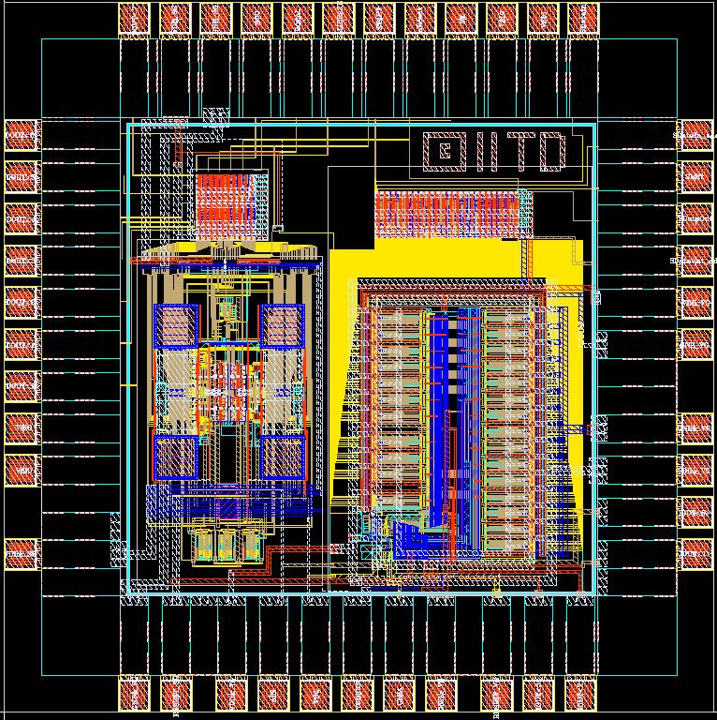
A configurable analog-to-digital conversion design using support vector machines and programmable analog VLSI blocks.
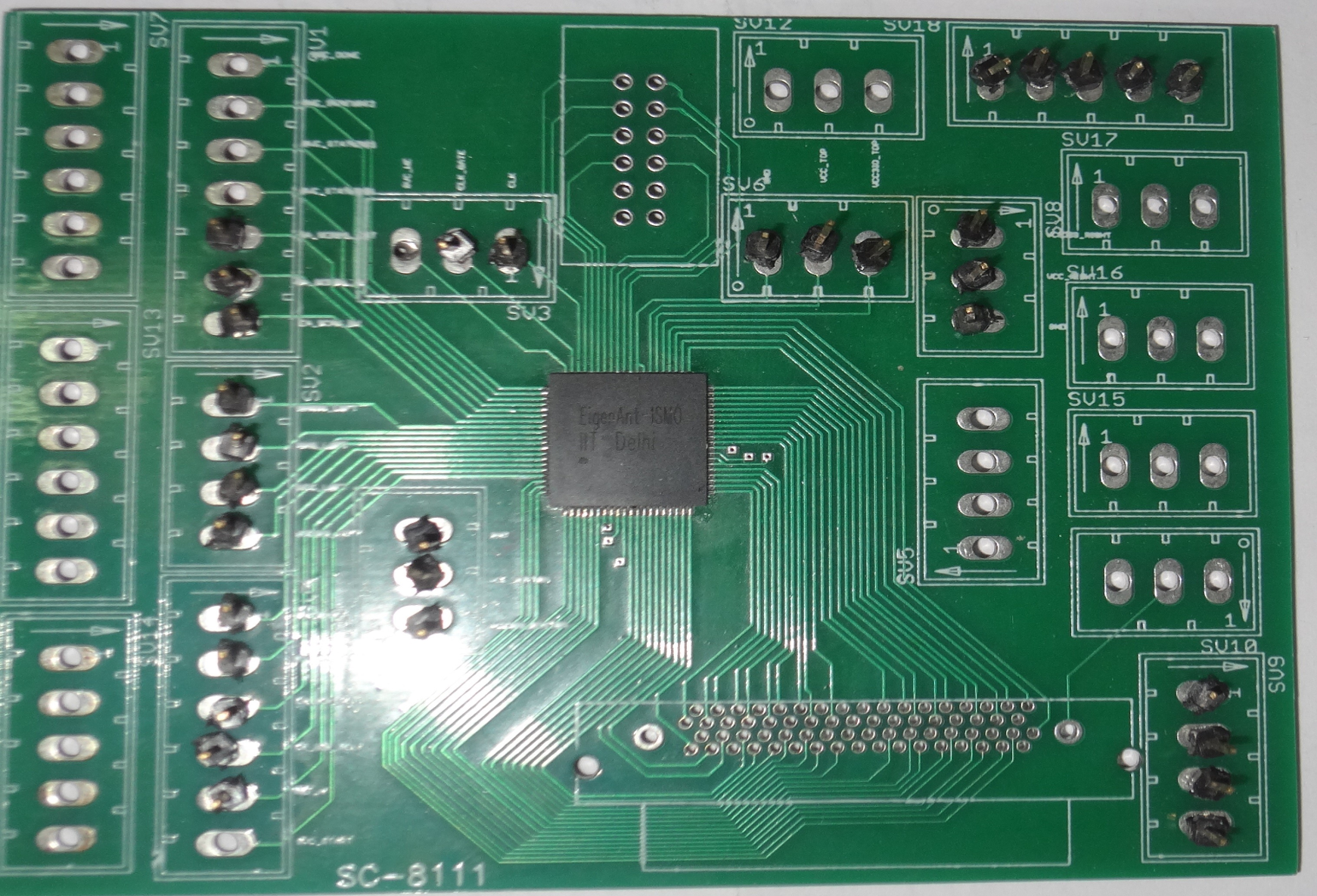
A VLSI implementation of EigenAnt, a mathematically grounded swarm algorithm for distributed shortest-path routing.
The Minimal Complexity Machine has led to variants for classifiers, regressors, ELM-like networks, and quantized models, with reported parameter reductions up to 300X in deep networks.
Hashing and learning methods have been applied to rare-cell discovery, cancer mutation scoring, and compact gene panels for blood-based NSCLC diagnosis.
Applications
The research program moves between mathematical learning models and demanding real-world domains where data are scarce, imbalanced, noisy, or difficult to represent.
Linear-time detection of anomalous cells from voluminous single-cell expression data using locality-sensitive hashing.
Deep learning and compact model approaches for mutation scoring and an 11 platelet-gene panel for NSCLC diagnosis.
Machine learning for cement literature, oxide glass properties, Brownian dynamics, and materials-science question answering.
Support Vector Machine based A/D conversion and online calibration for compensating non-idealities in analog VLSI blocks.
Academic Record
Numerical Optimization with Applications
Suresh Chandra, Jayadeva, Aparna Mehra
Narosa Publications, 2009
Twin Support Vector Machines: Models, Extensions and Applications
Jayadeva, Reshma Khemchandani, Suresh Chandra
Springer, 2017
Publications
A fuller publication archive can be expanded from CV, Google Scholar, BibTeX, or the existing IITD webpage.
Open selected publicationsFast and Scalable Hashing-Based Universal Graph Coarsening. IEEE TPAMI.
Discovery of rare cells from voluminous single cell expression data. Nature Communications.
Ants find the shortest path: a mathematical proof. Swarm Intelligence.