(i.)
Electrical Tuning of Photoelectrochemical Properties of Ferroelectric
Nanostructure NaNbO3 Films
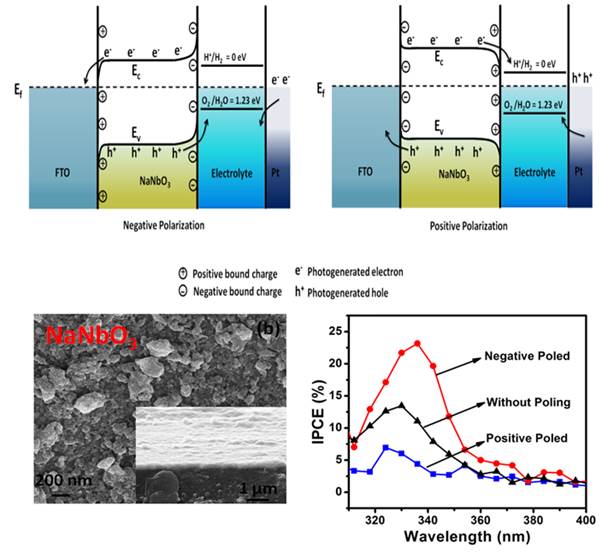
Photoelectrochemical
properties of NaNbO3 nanostructure ferroelectric films are
investigated, and it is demonstrated that the efficiency of
photoelectrochemical (PEC) water splitting can be tuned (7% to 23%) by
electrical polarization of the NaNbO3 films.
(ii.)
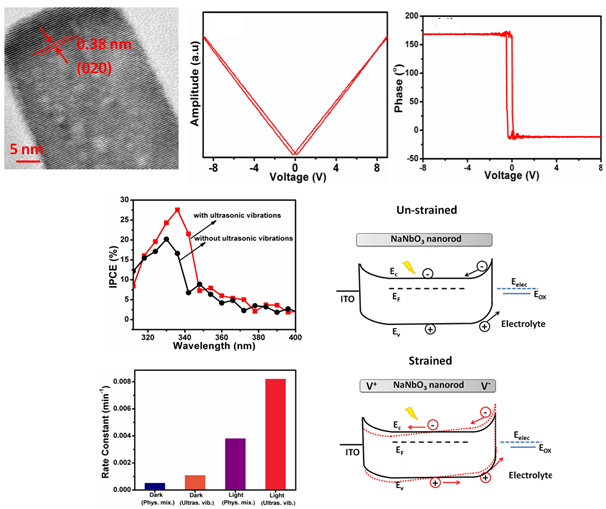
Coupling of Piezoelectric, Semiconducting and Photoexcitation Properties in
NaNbO3 Nanostructures for Controlling Electrical Transport:
Realizing an Efficient Piezo-Photoanode and Piezo-Photocatalyst
Demonstrate an efficient coupling between
piezoelectric, semiconducting and photoexcitation properties in chemically
stable NaNbO3 semiconductor with an aim to enhance the efficiency of
PEC water splitting and photocatalytic activities. It can be used as a
potential alternative material for piezophototronic applications.
(iii.)
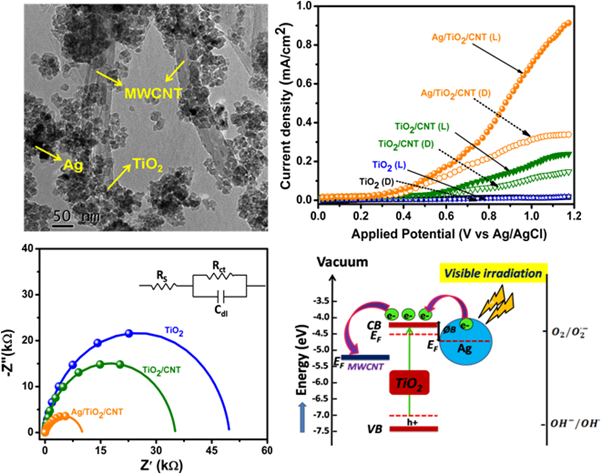
Plasmonic nanostructures based on TiO2/Ag/CNT
for photoelectrochemical water
splitting applications.
A visible light active
plasmonic photocatalyst, Ag/TiO2/CNT,
was synthesized by loading Ag
nanoparticles onto TiO2/CNT nanocomposite. The ternary Ag/TiO2/CNT
photoanode exhibits a ~4 times
higher photocurrent density (0.91 mA/cm2) as compared to the binary TiO2/CNT
photoanode (0.23 mA/cm2). The
enhancement in the photocatalytic activity is attributed to the synergistic
effect between Ag nanoparticles and MWCNT, which enhance the charge separation
efficiency by Schottky barrier formation at Ag/TiO2 interface and role of MWCNT as an electron reservoir.
(iv.)
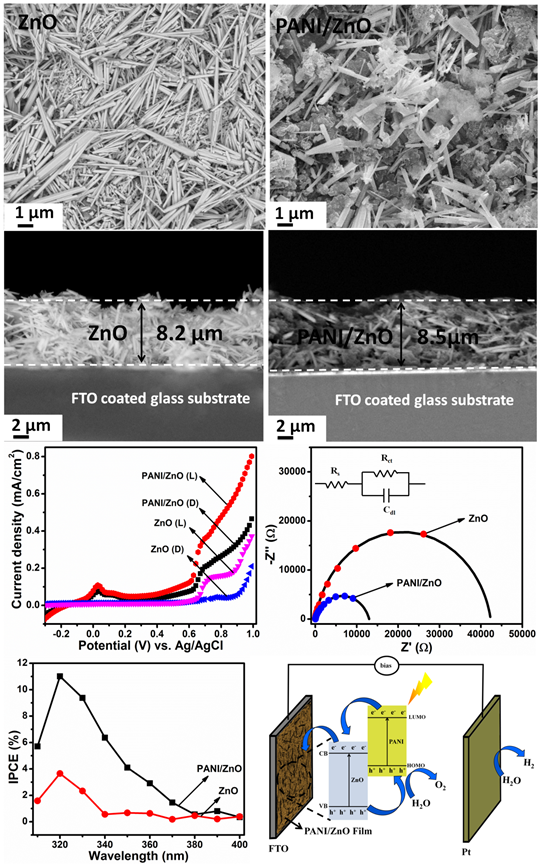
Photosensitization of zinc oxide nanorods with polyaniline for efficient
photoelectrochemical water splitting
Polyaniline (PANI) coupled Zinc oxide (ZnO) nanocomposite
has been synthesized by the chemisorption method. A ~3 fold enhancement in the
incident photon-to-electron conversion efficiency is observed for PANI/ZnO
nanocomposite as compared to bare ZnO nanorods. The observed enhancement in the
photoelectrochemical activity is attributed to the photosensitization effect of
visible light-responsive PANI and the formation of type-II heterojunction
between ZnO and PANI, leading to the efficient separation and faster transfer
of photoinduced charge carriers at the interface.