Research
The need for cleaner energy with target for net zero carbon emissions has led to the rapid evolution of novel technologies such as electrochemical energy conversion and storage. To rationally understand the underlying phenomena in electrochemical devices and thereby improve their performance, multiscale modelling of materials and interfaces involved is important. We apply multiscale modelling methods to address current challenges in clean energy applications and develop more sophisticated methods for such modelling.
Introduction
Energy is a central aspect in the human day-to-day life. Most of the utilized energy comes from burning of fossil fuels [1], which have been formed over millions of years of decomposition of plant and animal matter. Burning of fossils fuels has led to high amounts of CO\(_2\), which is a greenhouse gas. Concerns of increasing pollution, global warming, climate change, etc. have motivated humans to look for alternate energy sources that are environmentally benign. One of the ways of moving towards cleaner energy is to start utilizing renewable energy sources such as solar, wind, etc. The power from renewable sources cannot be utilized directly and one needs to convert these forms of energy into more useful and transmissible forms such electrical or chemical energy. E.g., solar panels and windmills convert solar energy into electrical energy. With the variations in natural sources like solar intensity and wind power throughout the day, their successful utilization also requires the use of energy storage devices. One of the ways of storing energy is to convert it into chemical energy. E.g. the energy can be used to charge a rechargeable battery such as the Li-ion battery [2], or can be utilized in splitting water to produce H\(_2\) [3,4]. Further to reduce the CO\(_2\) emissions, there is a movement towards electrification of the transport sector, which can be based on battery technology or fuel-cells [1]. Devices for electrochemical energy conversion and storage devices are being intensively pursued for these goals.
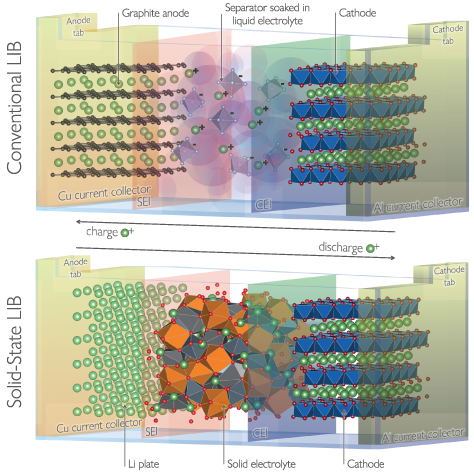
Fig. 1 A schematic of a conventional LIB with liquid electrolyte and a solid-state LIB with a solid electrolyte. Reproduced from Ref. [5] (CC by 4.0).
Fig. 1 shows a schematic of a single cell of a Li-ion battery (LIB) with structures of materials used for various components for a conventional LIB with a liquid electrolyte and for a solid-state LIB. During charging of the battery the Li-ions intercalate into the anode (typically Li/C(graphite)) and during discharging the Li ions intercalate into the cathode (typically a metal oxide such as \(\rm LiNi_xMn_yCo_zO_2\)) Atomistic modelling is a way to model the processes underpinning the functioning and performance of LIBs at the atomic-scale [5]. The power of computations lies in accurately predicting phenomena which can be hard to capture experimentally. The computations also provide more understanding and insight into atomic-scale phenomena which can be used to guide and design the experiments.
Research Methods
DFT and Linear-Scaling DFT
The many-body system of interacting ions and electrons (as in the case of electrochemical devices) can be described by the principles of quantum mechanics [6]. Density functional theory is a popular quantum mechanical theory widely used for the study of materials [7,8]. The total electronic energy of many-electron system can be written as an exact functional of the electron density, which only depends on the three spatial variables [9]. With an appropriate approximation for the exchange-correlation functional, a system with \(N\) electrons can be described with \(N\) single-electron eigenvalue equations [10]. The computational cost with conventional DFT scales proportional to the cube of the number of electrons \(\mathcal{O}(N^3)\), allowing calculations involving several hundreds of atoms on modern supercomputers as shown in Fig. 2
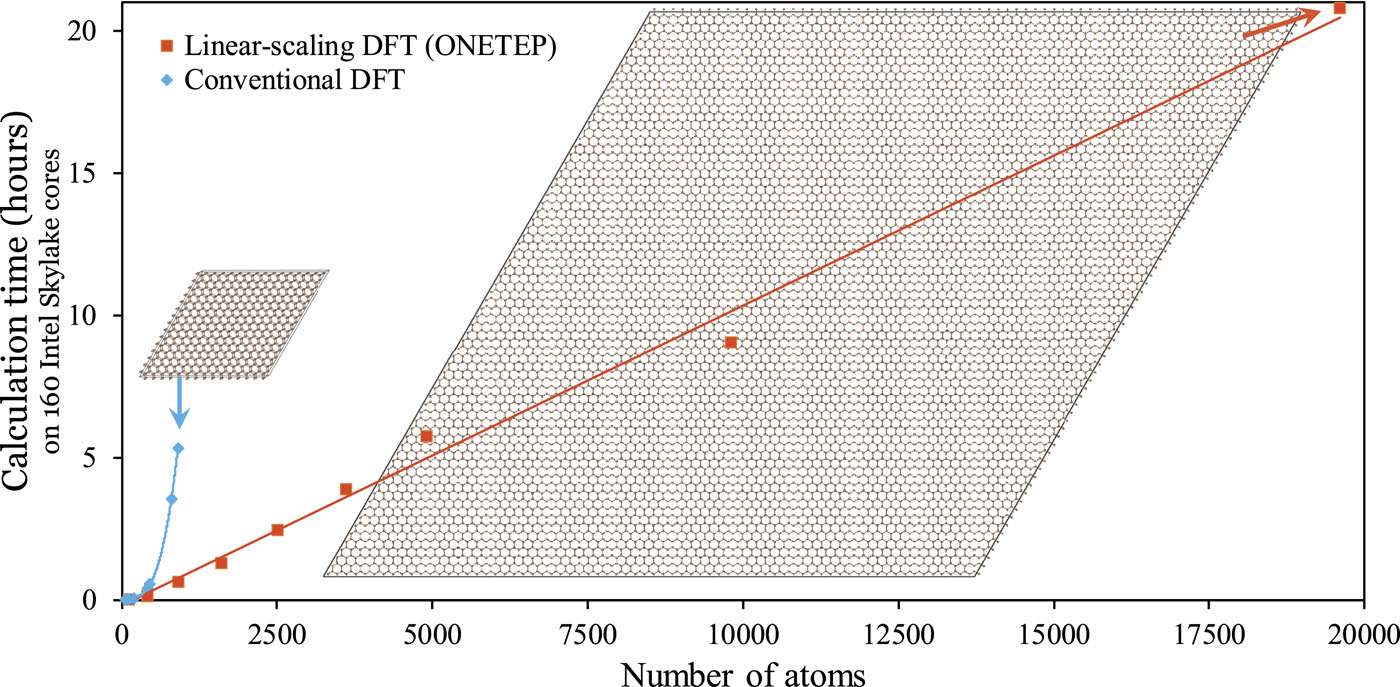
Fig. 2. Comparison of the computational time with the number of atoms for graphite using the ONETEP linear-scaling DFT code versus a conventional plane wave DFT code. Reprinted from Ref. [11], with the permission of AIP Publishing.
Many practical situations in materials research involve systems with thousands of atoms such the solid-electrolyte interphase (SEI), cathode-electrolyte interphase (CEI), simulation of defects, nanoparticle electrodes, proteins, polymers, etc. The need for large-scale atomistic simulations has led to the development of methods which scale linearly with the number of electrons \((N)\) [12]. Linear-scaling methods are based on the principle of ‘nearsightedness of electronic matter’ [13], according to which the density matrix decays exponentially with the distance and can be truncated beyond a cutoff. We use the linear-scaling method ONETEP, \(\mathcal{O}(N)\) Electronic Total Energy Program for DFT calculations with thousands of atoms [14]. Within ONETEP, the total energy is directly minimized with respect to the localized orbitals and the density kernel. The absence of any diagonalization procedure and the use of sparse matrices and algorithms allows DFT calculations with linear-scaling computational cost as shown in Fig. 2. This unique feature of ONETEP opens avenues for study of complex material systems with tens of thousands of atoms with DFT-level accuracy.
Grand canonical DFT
Electrified electrode electrolyte interfaces (EEEI) are frequently encountered in electrochemical devices used for energy conversion and storage. Rational design and systematic improvement in performance of electrochemical devices is possible with the development of more realistic electrolyte models integrated within the framework of DFT. Current state-of-the-art DFT-based methods allow simulations of periodic bulk solids and solid surfaces in vacuum, as shown schematically in Fig. 3 (a). Such description of the system does not include the effect of surrounding electrolyte environment and the connection with the electrical wire, which would allow the electrons to flow and the charge on the system to vary under operating conditions. An experimental setup, as shown schematically in Fig. 3 (b) has quite different electrochemical conditions. Firstly, the contact with the electrical wire allows variation in number of electrons in the system. Secondly, the working electrode on the right is set at a potential (U) with respect to the reference electrode, which constrains the electrochemical potential of electrons. Thirdly, as the number of electrons can vary in the system, the electrode carries a net charge. This net charge on the electrode is neutralized by a build-up of counter-electrolyte charge near the surface resulting in the formation of double layers.
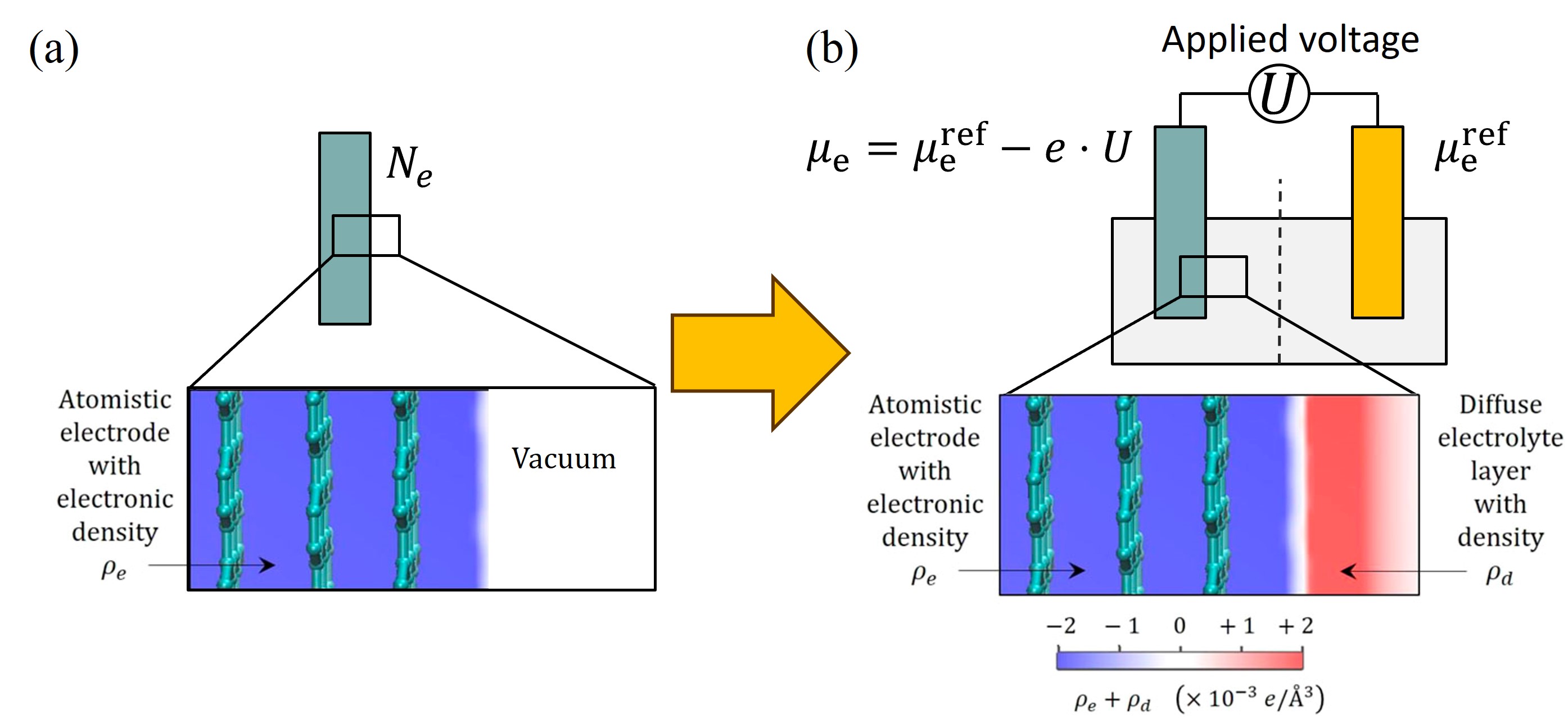
Fig. 3. Comparison of (a) conventional setup for charged-controlled canonical DFT in vacuum (cDFTv) and (b) potential-controlled grand canonical DFT in electrolyte (gcDFTe).
To simulate electrified electrode electrolyte interfaces (EEEI) under electrochemical conditions, we have developed a novel grand canonical DFT method within ONETEP which allows for electrochemical simulations under potential control [15]. We have also developed methods that would allow neutralization of such extended charged systems via a Poisson-Boltzmann electrolyte [11,16]. The model parameters have been calibrated according to the experimentally observed reduction potentials of standard reference electrodes [15], and activity coefficient of electrolytes in Li-ion batteries [16]. The method has also been tested to predict the differential capacitance of few-layer graphene based electrodes in agreement with experiments [15]. The integration of this model within the linear-scaling ONETEP opens the doorway for large-scale simulations of electrochemical systems under realistic conditions. We have demonstrated the application of the model in prediction of the Li nucleation and dendrite growth on graphite anode of Li-ion battery [17].
Examples
Li nucleation on graphite anode in Li-ion batteries
Li plating on the anode is a side reaction in Li-ion batteries which competes with Li intercalation and leads to loss of capacity. Growth of Li clusters into dendrites is a potential safety hazard for batteries which can lead to internal short-circuit and fires. We consider two possibilities of Li deposition on the surface of graphite anode: deposition of Li+ ions uniformly on the surface and deposition of clusters of metallic Li. Using ab initio simulations, we predict the operating voltage for the occurrence of the above processes and safety measures to prevent dendrite growth in batteries. We find that Li deposition occurs in the following stages: at positive voltages vs. Li, surface deposition of Li+ ions is the dominant process. Below a critical cross-over voltage, the process of reduction of aggregated Li+ ions and the formation of metallic Li clusters takes over. This cross-over voltage is found to be −12 mV on the basal plane of unlithiated graphite and −29 mV on lithiated graphite. To prevent formation of Li clusters and for safe operation of Li-ion batteries, the voltage on the graphite anode should be kept above the cross-over value. Check ref. [17] and [18] for more details.
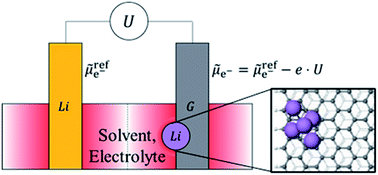
Fig. 4. Schematic of voltage driven Li nucleation on the graphite anode.
References
[2] J.B. Goodenough, Y. Kim, Challenges for rechargeable Li batteries, Chem. Mater. 22 (2010) 587–603.
[6] A. Szabo, N.S. Ostlund, Modern quantum chemistry: introduction to advanced electronic structure theory, Courier Corporation, 2012.
[7] R.O. Jones, Density functional theory : Its origins , rise to prominence , and future, 87 (2015).
[9] P. Hohenberg, W. Kohn, Inhomogeneous Electron Gas, Phys. Rev. 136 (1964) B864–B871.
[12] S. Goedecker, Linear scaling electronic structure methods, Rev. Mod. Phys. 71 (1999) 1085–1123.