Published research
-
Molecular dynamics simulation-based trinucleotide and tetranucleotide level structural and energy characterization of the functional units of genomic DNA
DOI: https://doi.org/10.1039/D2CP04820E
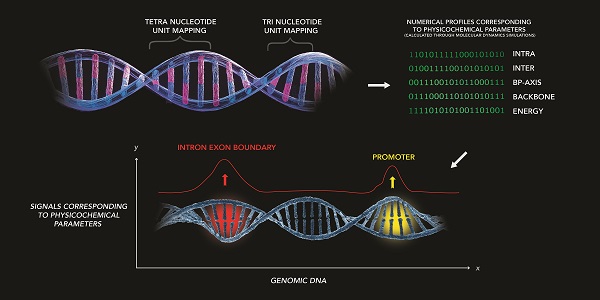
Abstract: Genomes of most organisms on earth are written in a universal language of life, made up of four units – adenine (A), thymine (T), guanine (G), and cytosine (C), and understanding the way they are put together has been a great challenge to date. Multiple efforts have been made to annotate this wonderfully engineered string of DNA using different methods but they lack a universal character. In this article, we have investigated the structural and energetic profiles of both prokaryotes and eukaryotes by considering two essential genomic sites, viz., the transcription start sites (TSS) and exon–intron boundaries. We have characterized these sites by mapping the structural and energy features of DNA obtained from molecular dynamics simulations, which considers all possible trinucleotide and tetranucleotide steps. For DNA, these physicochemical properties show distinct signatures at the TSS and intron–exon boundaries. Our results firmly convey the idea that DNA uses the same dialect for prokaryotes and eukaryotes and that it is worth going beyond sequence-level analyses to physicochemical space to determine the functional destiny of DNA sequences.
-
Exon-Intron Boundary Detection Made Easy by Physicochemical Properties of DNA [PREPRINT]
DOI: https://doi.org/10.21203/rs.3.rs-4359229/v1
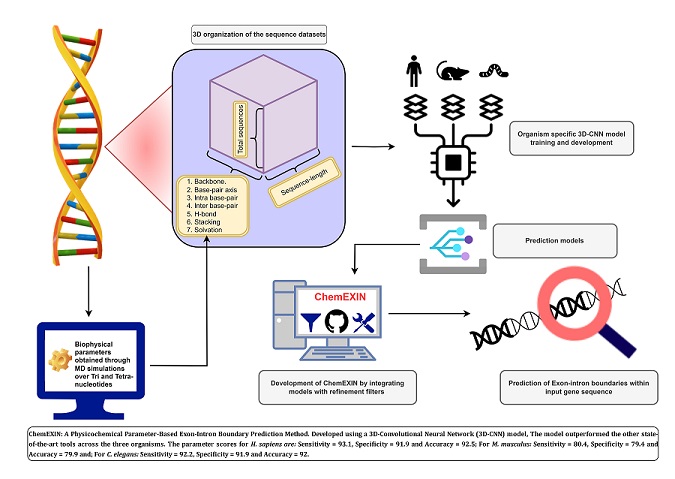
Abstract: Genome architecture in eukaryotes exhibits a high degree of complexity. Amidst the numerous intricacies, the existence of genes as non-continuous stretches composed of exons and introns has garnered significant attention and curiosity among researchers. Accurate identification of exon-intron boundary junctions is crucial to decipher the molecular biology governing gene expression of regular and aberrant splicing. The currently employed frameworks for genomic signals, which aim to identify exons and introns within a genomic segment, need to be revised primarily due to the lack of a robust consensus sequence and the limitations posed by the training on available experimental data sets. To tackle these challenges and capitalize on the understanding that deoxyribonucleic acid (DNA) exhibits function-dependent local structural and energetic variations, we present ChemEXIN, an innovative method for predicting exon-intron boundaries. The method utilizes a deep-learning (DL) model alongside tri- and tetra-nucleotide-based structural and energy parameters. ChemEXIN surpasses current methods in accuracy and reliability. Our work represents a significant advancement in exon-intron boundary annotations, with potential implications for understanding gene expression, regulation, and biomedical research.
Ongoing Projects
-
Physico-chemical fingerprinting of Genomic elements.
Working with the hypothesis that genomic DNA sequences must convey their functional roles through their biophysical properties. We are characterising Promoters, Exon-start, Exon-end, Enhancers, UTRs and CDS to differentiate them on the basis of their structure and energy profiles.