1 2 3 4 5 6

Spontaneous imbibition or capillary driven flow is important for oil recovery from fractured reservoirs, diagnostic devices, capillary pumped loops etc. Generally, these porous media are heterogeneous and the heterogeneity is due to the layering of the porous medium. Interplay of viscous, gravity and capillary forces govern the location of the leading front. Earlier studies showed that leading front is in the narrowest pore due to high capillary forces. However in our research we have shown that the leading front is strongly dependent on the layring and in many cases with high heterogeneity the front in the narrow pores will lag. For more information you can read here, here, and here. We also work on forced imbibition in a layered porous medium. A part of the forced imbibition project is funded by ONGC-IRS
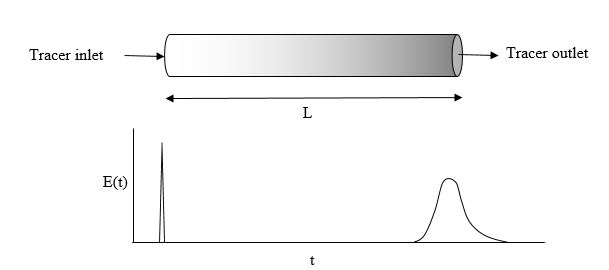

The porous media characterization in large oil and gas reservoir and groundwater aquifers pose a challange due to inaccessibility of the porous media for visual inspection. Tracers are generally used for characterization of these porous media. In our lab, we explore the tracer transport to quantify the immobile volume in the reservoir and we are working on a method to quantify the wetted surface by a phase in during multi-phase flow. The related publications from our lab are : here and here This project is funded by BRNS.


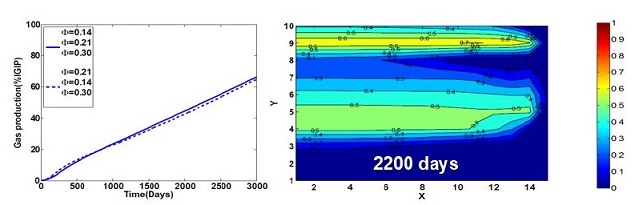
The uncertainty in measuring reservoir parameters like permeability, porosity is quite high. Using deterministic simulations to forecast the production can lead to over-prediction or under-prediction of oil reserves using reservoir simulation. Monte-Carlo simulations are computationally expensive, while Design of Experiments method, which is generally used, neglects the probability distribution of the reservoir parameters. We use Polynomial Chaos Expansion to quantify uncertainty in the reservoir simulation predictions given the prior probability of the reservoir parameters. For history matching, bayesian inference can be used to quantify the priors once the actual production data becomes available.


Methane hydrates are ice-like compounds, which store methane in huge volumes at high pressure and low temperature. Naturally occuring reservoirs of methane hydrates can become potential energy resource. We use an in-house methane hydrate reservoir simulator to explore the production methodologies for heterogeneous methane hydrate reservoirs. The related publications from our lab are : here and here This project is funded by SERB.


The data generated from the reservoirs is huge, for example seismic data. For interpretation of these data sets, we recently started exploring machine learning techniques to find faults and horizons. This project is funded by Schlumberger, under Schlumberger Center of Excellence for oil and gas industry.


Asphaltenes are heavy components in crude oil which are difficult to remove from sand particles in reservoirs, pipelines outside the reservoir and in refineries. We use AFM to understand the interaction of asphaltenes with these inorganic substances.