Solid Mechanics for Undergraduates
using vectors and tensors
(Limited web edition: refer to printed book for complete access)

The printed book is available at:    Amazon     Preview of printed book

If you would like to share any feedback/comment: click here

If you are an instructor, you can request solution to the unsolved objective questions in the printed book by writing to the author.
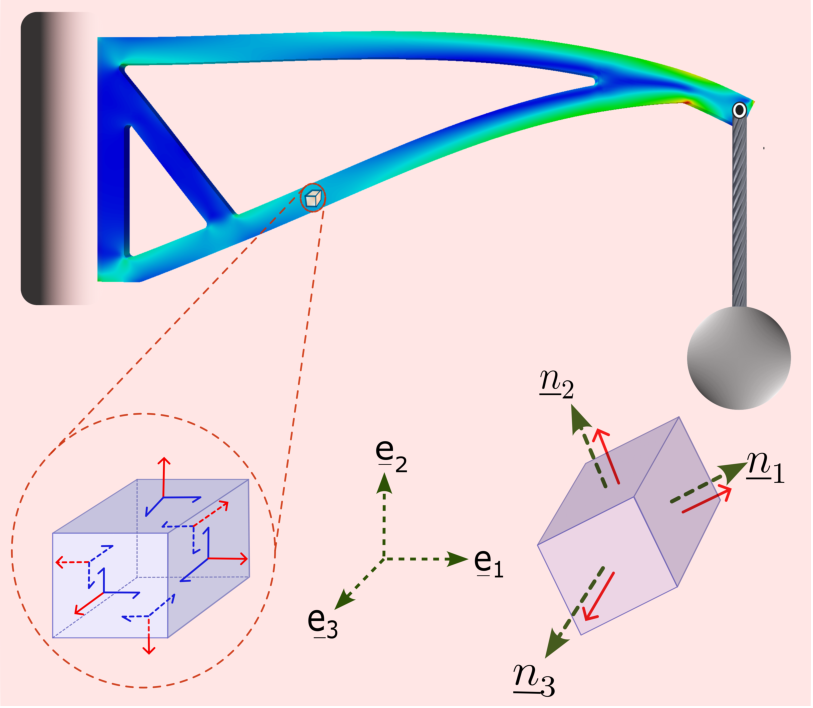
PIC

Ajeet Kumar
Dept. of Applied Mechanics
Indian Institute of Technology (IIT) Delhi


Contents

Preface
1 Mathematical Preliminaries
 1.1 A vector and its representation: NPTEL link
 1.2 Dot-product, Cross-product and Tensor-product of two vectors: NPTEL link
 1.3 Second order tensors and their representation: NPTEL link
 1.4 Multiplying a second order tensor with a vector: dot product and tensor product: NPTEL link
 1.5 Multiplying two second order tensors: single-contraction, double-contraction and tensor product: NPTEL link
 1.6 Calculus of tensors: divergence and gradient
 1.7 Rotation tensor: NPTEL link
 1.8 Solved examples
 1.9 Objective questions to recall concepts
 1.10 Questions to practise
2 On Traction Vector, Stress Tensor and Stress Matrix
 2.1 Definition of traction vector: NPTEL link
 2.2 Relating traction on different planes at a point: NPTEL link
 2.3 Stress Tensor: NPTEL link
 2.4 Stress matrix as a representation of stress tensor: NPTEL link
 2.5 Transformation of Stress matrix: NPTEL link
 2.6 Solved examples
 2.7 Objective questions to recall concepts
 2.8 Questions to practise
3 Stress Equilibrium Equations
 3.1 Linear momentum balance: NPTEL link
 3.2 Angular momentum balance: NPTEL link
 3.3 Derivation of traction boundary condition: NPTEL link
 3.4 Solved examples
4 Maximizing Normal and Shear components of Traction
 4.1 Finding principal planes: NPTEL link
 4.2 Properties of Principal Planes: NPTEL link
 4.3 Maximizing shear component of traction: NPTEL link
 4.4 Mohr’s circle: NPTEL link
 4.5 Mohr’s stress plane: NPTEL link
 4.6 Stress invariants: NPTEL link
 4.7 Hydrostatic and deviatoric parts in stress tensor: NPTEL link
 4.8 Solved examples
5 On Strain Tensor and the associated Strain Matrix
 5.1 Longitudinal strain in a general body: NPTEL link
 5.2 Reference and deformed configurations: NPTEL link
 5.3 Relating line elements in reference and deformed configurations: NPTEL link
 5.4 Formula for longitudinal strain: NPTEL link
 5.5 Formula for shear strain: NPTEL link
 5.6 Formula for volumetric strain: NPTEL link
 5.7 Strain tensor: NPTEL link
 5.8 Local rotation tensor: NPTEL link
 5.9 Strain compatibility conditions: NPTEL link
 5.10 Similarity between stress and strain tensors: NPTEL link
 5.11 Solved examples
6 Stress - Strain relation
 6.1 Linear stress-strain relation: NPTEL link
 6.2 Independent components in stiffness tensor: NPTEL link
 6.3 Voigt Notation: NPTEL link
 6.4 Isotropic materials: NPTEL link
 6.5 On Young’s modulus, shear modulus and Poisson’s ratio: NPTEL link
 6.6 Isotropic thermoelasticity: NPTEL link
 6.7 Anisotropic materials: NPTEL link
 6.8 Inelastic behavior: NPTEL link
 6.9 Solved examples
7 Solving Axisymmetric Problems: Extension, Torsion and Inflation
 7.1 Cylindrical coordinate system: NPTEL link
 7.2 LMB Formulation:NPTEL link
 7.3 Strain matrix in cylindrical coordinate system: NPTEL link
 7.4 Relating stress and strain in cylindrical coordinate system: NPTEL link
 7.5 Extension, torsion and inflation of cylinders: NPTEL link
 7.6 Solving the simplified equations: NPTEL link
 7.7 Solved examples
8 Bending of Beams
 8.1 Pure bending of beams: NPTEL link
 8.2 Non-uniform bending of beams: NPTEL link
 8.3 Bending of unsymmetrical beams: NPTEL link
 8.4 Concept of shear center: NPTEL link
 8.5 Solved examples
9 Theory of Beams
 9.1 Motivation for beam theory: NPTEL link
 9.2 Euler-Bernouli Beam Theory: NPTEL link
 9.3 Timoshenko Beam Theory: NPTEL link
 9.4 Buckling of Beams: NPTEL link
 9.5 Solved examples
10 Energy Methods
 10.1 Linearity and superposition of elasticity equations: NPTEL link
 10.2 Energy stored in the body due to a applied force: NPTEL link
 10.3 Reciprocal relation: NPTEL link
 10.4 Generalized forces and generalized displacements: NPTEL link
 10.5 Castigliano’s First Theorem: NPTEL link
 10.6 Application of Castigliano’s theorem for solving beam problems: NPTEL link
 10.7 Solved examples
11 Theory of Failure
 11.1 Various theories of failure
 11.2 Solved examples